Inside the Minds of AI’s Builders
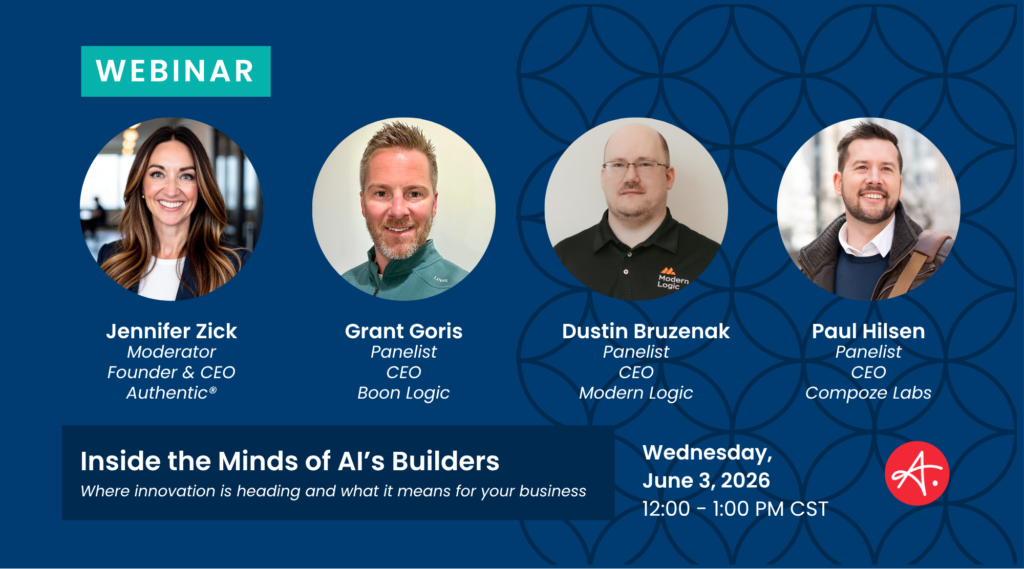
In this Authentic Growth® webinar, founder and CEO Jennifer Zick is joined by three builders working at the frontier of AI development: Grant Goris (CEO and co-founder, Boon Logic), Dustin Bruzenak (CEO, Modern Logic), and Paul Hilsen (CEO and co-founder, Compoze Labs). Together they offer a practitioner’s view of where AI adoption actually stands and where it’s headed next.
The conversation covers real-world client deployments across healthcare, government, manufacturing, and defense; the data foundation problem that blocks most organizations from capturing AI’s full value; what it actually looks like when a company moves from using AI as a tool to leveraging it for true transformation; and what business leaders should be thinking about as release cycles accelerate and the competitive landscape shifts beneath their feet.
Watch the Webinar
Key Takeaways
- No one is as far behind as they feel — the entire market is still early in the AI adoption cycle, and the companies that are winning are the ones that start experimenting now rather than waiting for certainty.
- Your data foundation is the ceiling on your AI ambitions. Organizations that skipped the work of cataloging, cleaning, and integrating their data will hit hard limits on what they can build — regardless of how good the AI models get.
- The shift from AI as a tool to AI as a co-worker is already happening. Agentic AI can now execute multi-step workflows end-to-end, and leaders who haven’t updated their mental model of what AI can do are operating on last year’s assumptions.
- Building AI natively into your product or process — rather than bolting it on — is what creates durable competitive advantage. Companies redesigning from the ground up are outpacing incumbents trying to patch legacy systems.
- AI governance and culture have to come from the top. Providing access to tools without leadership clarity, guardrails, and resources for learning will slow adoption and erode trust rather than accelerate it.
- The investment you make in context — teaching AI about your business, your workflows, and your standards — is portable across platforms and will compound in value over time, regardless of which model you’re using.
Webinar Transcription
Opening & Welcome
Jennifer Zick: Welcome to the Authentic Growth® Webinar. If you had planned to attend a webinar on getting inside the minds of AI’s builders, congratulations — you’re in the right spot. I am Jennifer Zick, founder and CEO of Authentic. Delighted to be your host today.
Authentic is a fractional CMO firm. We serve clients all across the US and sometimes beyond. The clients we work with are generally established growth businesses, usually between $10 million to $250 million in revenue. They’re on a growth trajectory and they know it’s time to overcome random acts of marketing and move confidently into the next stage of growth.
We help them do that by matching them with a right-fit fractional CMO and a full marketing operating system — and a big part of how we’re doing that is by helping our customers leverage AI solutions on the marketing side of the world, but also across their business and every touch point that impacts revenue and efficiency. So even though we are not a technology solutions development company, we hang around with a lot of smart tech people. Today I’ve invited three of those smart tech people to join me so that we can learn from them — the builders of AI solutions in a lot of different shapes and forms.
This is the third in our series of three AI webinars over the last couple of months. We started with marketing leaders, then most recently we had a conversation with CEOs about what it feels like to be in the hot seat of AI innovation right now. Today I wanted to get with this crew of technologists who are spending their days looking around the corner — to help us see where things might be going next and keep a balanced perspective on what it means to innovate while actually running a real business at the same time.
So without further ado, let me introduce you to my panelists. I’m going to start with Grant.
Grant Goris: Hey, Jennifer — thanks for having me. I’m Grant, CEO and co-founder of Boon Logic, an AI software company in Minneapolis. We’ve developed solutions and capabilities that bring high-speed baseline intelligence to a variety of different markets. We live at a very low level in the world of AI, but we enable a lot of really cool things that resonate with consumers as well as large organizations.
Jennifer Zick: Thanks, Grant. Dustin?
Dustin Bruzenak: Hey there. Dustin, ModernLogic. We help businesses and government agencies implement complex technology and then maintain it — everything from your website all the way down to AI. We’ve done big projects for state governments, small projects for startups, and we work a lot in regulated fields like HIPAA and defense. We really help people break the data barriers down, integrate new technology, and then keep it alive. Because you’ve invested a lot of money, and people often think about building but don’t think about how they’re going to keep it running. That’s a big part of our business.
Jennifer Zick: Thank you, Dustin. And Paul?
Paul Hilsen: Hi everyone. Paul Hilsen, CEO and co-founder of Compose Labs. We’re a software development and AI consulting company. We bring clients through what I call our Triple D process: Discover, Design, Deliver. What’s your strategy, what are you trying to build — all the way through implementation. We’re based here in Minneapolis as well.
What’s Being Built Right Now
Jennifer Zick: Dustin, you’re always building something over at ModernLogic. Let us into your world a little bit. What are you working on in terms of AI solutions and agents, where are your clients deploying these, and what has you most energized right now?
Dustin Bruzenak: We’re still pretty early in the AI adoption cycle. When you look at AI adoption across clients and industries, the good news is no one’s really behind. Everyone is in that phase of using the tools, figuring out what governance is, and figuring out how to deploy in secure environments. A big part of where we’re helping clients is: how do we bring this in a way that’s safe and secure, and then break down the barriers between traditional data silos — your ERP, your CRM, your email — and get all that into a secure enclave where you can apply AI?
One example: we just wrapped a project with a state tourism department. They have something like 100,000 assets they need to manage and maintain to advertise their tourism. Maintaining that as a state government was actually impossible prior to AI. We built a system that aggregates all that data and allows them to do analysis on what are the best cities to advertise and how to reach potential visitors.
We’re also helping a major healthcare research university build a HIPAA-compliant AI system so patients can record longitudinal events between their six-month doctor visits — things like flare-ups that might be pertinent to their diagnosis but that they’d typically forget or overlook. The AI infers from those events in a way that’s meaningful for the doctor, rather than the doctor only hearing about the last two weeks.
Jennifer Zick: Thank you for starting by acknowledging that we might all feel behind — but we’re not. Everybody’s figuring this out together. Paul, give us a window into your world right now.
Paul Hilsen: What’s exciting right now is that agentic AI has gone from telling you about things to actually executing — doing workflows, doing tasks. I’ll give you an example. We completed a project in 2025 with a company that had humans reviewing hundreds if not thousands of RFPs a day. They sold televisions to schools and governments — a $50 to $80 million company with a huge manual workload. A human had to read an RFP, understand what was being asked for, figure out if it matched their business, and if yes, write a summary, enter it into the CRM, and kick off downstream processes. What used to take seven to eight days now takes minutes to review thousands of RFPs.
Two things stand out. One, the direct efficiency gain — one human can now do the work of ten. But two, and this is often overlooked: they’re now processing every single RFP in the market, categorizing it, understanding what it’s asking for, and building data to drive strategic decisions. When they want to grow into a new domain, they have the data to back that. As far as I know, they’re the only company in the world doing this at this level. It’s a huge competitive advantage that wouldn’t be feasible without AI.
Jennifer Zick: That’s an amazing use case. How often are clients’ innovative AI ideas roadblocked by a completely disorganized CRM or data environment?
Paul Hilsen: Your data foundation is directly correlated to how much value you can capture from AI. If the clean, cataloged data footprint is small, you can only go so high — it’s like a skyscraper. A strong foundation allows you to go tall. In many cases, 95% of the work on an AI solution is fundamental data engineering. Maybe 2–5% is the AI component itself. Eat your broccoli. You need that foundation in place.
Jennifer Zick: We still need some humans cleaning things up to help the bots do their jobs. Grant, what’s going on in your world that’s exciting right now?
Grant Goris: We’ve been in the AI space since before the generative tools — through deep learning, machine learning, back to just engineering. We incorporated in 2018. What’s exciting is that what seemed like waves we kept almost catching — AI would generate buzz and then lose traction because the infrastructure wasn’t there, the data was a mess — we’re finally getting to the place where it’s here to stay. Industries and roles are starting to catch the wave and see real ROI.
Even in regulatory environments. We do work in pharmaceutical manufacturing under FDA oversight and in the defense space. When regulators start coming on board and issuing guidance for AI involved in a process, that’s a sign of maturity. It’s becoming household — consumers are using it in daily life and bringing those experiences into their professional world.
The other thing I’m excited about is edge-native AI. Everything first happens locally, then there’s a push to the cloud, and now we’re seeing things come back to the edge — edge-native AI PCs with tools built in. That’s going to build familiarity and trust much faster. And trust is a critical component. Once it’s there, that’s where you really see the efficiencies.
What’s Moving Faster Than People Realize
Jennifer Zick: Grant, what’s moving faster than people realize right now, and what shifts are going to catch us off guard in the next six to twelve months?
Grant Goris: The release cycles are accelerating in ways most people don’t realize unless they’re living in these tools. Right now I have Opus 4.8 pulled up — and that will be 4.9 far faster than anybody expects. The changes version over version are significant, and it’s not once every six months — Claude, for example, is using its own tools to write the next versions, and we’ve seen three release cycles in the last several weeks. So if someone pushed AI aside a year ago because of hallucinations or data accuracy issues and said they’d revisit in 18 months — that is an eternity in this space.
The second thing is self-learning is accelerating deployment cycles. Traditional deep learning five years ago required massive amounts of human input, tuning, and data labeling — deployment cycles were months or quarters. Now you’re down to days, or even minutes for certain tasks. That cycle of iteration is shortening dramatically.
Which brings me to the competitive threat: smaller companies that are adopting and building on AI are going to start achieving product parity — even product advantages — over incumbents at far lower operating cost. They’ll be punching well above their weight. In the defense space, a company most people had never heard of started winning $8 billion, then $20 billion contracts over prime contractors who have dominated the market for decades. That’s what rapid AI-native development can do.
Jennifer Zick: Awe-inspiring and a little sobering at the same time. Paul, where are you seeing the biggest gaps between what AI can do and what organizations are actually ready for?
Paul Hilsen: It depends on the company. But I’ll be pointed here. I show clients an image of a bodybuilder — enormous upper body, tiny chicken legs. The upper body is your AI ambitions. The legs are your data strategy. There are firms with great ideas and great concepts for where they want to go, but they’ve skipped leg day for decades. They don’t have the foundation in place.
Firms that did the foundational work — back when it was called digital transformation or digital modernization, which was really just getting your data cataloged and accessible — are the ones who can now move fast. They already have clean data, they have their Power BI dashboards, they have the integration layer in place. Guess what? You can now build agentic AI on top of that. The firms that didn’t do that work are hitting roadblocks they didn’t anticipate.
The good news is this isn’t concrete — you can take vertical slices. In our AI bootcamps with executives, we identify the use cases that will move the needle the most. What would it mean if this process went from weeks to minutes? If the answer is $10 million a year and it costs $500K to build, that’s a no-brainer. That’s how I’d frame the conversation.
The other thing is that AI as a culture has to come from the top down. Your governance needs to provide guidance that says: yes, we want you to use AI, here are your left and right bounds, go experiment, and if you hit a guardrail, good — keep bouncing off those walls. The firms that can provide that systematically are going to move faster and more confidently.
Dustin Bruzenak: On the other side of that, cultures resist change because people are busy and don’t have time to learn new things. You have to pair governance with ownership that’s pro-AI, understands the capabilities, is excited about it, and provides the resources — training, access to tools, time in one-on-ones, space for teams to share wins. You can’t just change culture by saying, here’s access to Claude and Cowork, now everything will magically change.
This is normal technology adoption. Thinking about it in terms of ERP or CRM implementations — there’s an adoption timeframe, resources needed, training required, mindset shifts. We have decades of experience with digital transformation. AI doesn’t mean all of that goes out the window. And one practical thing: the barriers to integrating legacy data are dramatically lower now. We integrated a COBOL-based AS/400 system that had been sitting in a closet for 40 years — it’s now working with AI, and it took us a week.
Tools vs. Transformation
Jennifer Zick: There’s a really big difference between using AI as a tool and leveraging AI to reshape how the business operates. Most companies I know are in the tool phase — using ChatGPT or Claude as a thought partner. What does it look like when a company starts to make the leap to real transformation, and what has to be true for that to work?
Grant Goris: Leadership has to be on board and pointing a general direction. But you also have to pass a level of autonomy to your engineering teams. They’re smart people who know the work. Manufacturing went through this with automation — there was resistance, a feeling that it was a threat to livelihoods. But it elevated people out of monotonous work and into higher-level things. One of our taglines is elevating human intelligence. It’s not replacing it.
The bigger shift I’m seeing is around AI as a native capability versus a bolt-on. A lot of companies are keeping everything they’ve built and just slapping some AI on top and calling it AI-powered. Those that are thinking about AI as native — re-architecting from the ground up with AI ingrained in everything — are going to see a fundamentally different product. We do this in pharmaceutical visual inspection. We built from the ground up with a proprietary algorithm, entirely around that core capability, and it’s delivering better results than incumbents who are patching legacy computer vision systems.
A friend of mine, a custom home builder in the Twin Cities, built software for his business — the first version took about two years. He sold it, bought it back, and rebuilt the entire thing in about six weeks — now fully AI-native and automated. The capacity to deliver higher-quality product on faster cycles is on a completely different level.
If I had to summarize three things that have to be true: the work has to be worth redoing — not everything gives you enough lift to justify the rebuild. The system has to be trusted — one misstep, especially customer-facing, can destroy credibility that took a long time to build. And your data has to be there — if AI doesn’t have access to relevant information about your business, it’s going to give you a vanilla answer.
Paul Hilsen: I want to build on what Grant said about what’s worth rebuilding. In the military, there was a point where instead of starting with an airplane and putting a gun on it afterwards — which limited range, caliber, rotation — the US redesigned with the gun first and built the plane around it. That redesign-from-intent approach led to a huge advantage. So really think about: what is it that I’m going to do with AI that gives me that competitive edge? Grant described it perfectly.
Leading Through Fear and FOMO
Jennifer Zick: There’s a dual reality out there — this is energizing and also really scary and overwhelming. Fear of being left behind, fear of job displacement, fear of making the wrong bet. You live in this space every day and seem genuinely energized. What would you say to a CEO who’s leading from anxiety right now rather than vision?
Dustin Bruzenak: I’m a fifth-time founder, so fear is not really part of my DNA — take that with a grain of salt. But for most people, feeling both excited and afraid is the feeling of sanity. You should be a little of both. It creates caution, keeps you clear-headed, stops you from adopting too much or too little. Just don’t let it cripple you.
In terms of excitement — my business is changing more every two weeks than it has over the last 15 to 20 years. We’re not just doing things faster; we’re unlocking new capabilities and new ways of delivering value that literally did not exist before. One question I like to ask: imagine your business when the cost of producing knowledge drives down to zero or near zero. What more can you do for your customers? What does value delivery look like?
We saw a real shift in December and January of this year where AI models went from thought partners to co-workers. You can now let them do the work. And anyone saying they can’t do competent work hasn’t used the new AIs appropriately. If you’re still talking about prompt engineering, you’re behind — this year it’s about context engineering. How do you teach it about more of your business so it can do more work for you?
One concrete example: we can now have a discovery meeting with a client, the transcript goes to AI with no human reading it, and it produces the statement of work, the project plan — which automatically populates our project system, where developer AIs plan how they’re going to do the work. The developer shows up in the morning with ten plans for ten things. That state government project I mentioned? We completed it one month early with twice the scope. That never used to happen.
I heard a great quote recently — Andrej Karpathy said it: AI is a chainsaw, not a kitchen knife. There are places you need a kitchen knife, and places you need a chainsaw. Humans are still very much in the equation — learning how to use the chainsaw appropriately, when to apply it, when to apply wisdom. Think of it as being given the world’s best power tool to use at your desk. Don’t think of it as a robot sitting in your seat.
Jennifer Zick: Great guidance. Paul, if you could sit down with every CEO in the audience over coffee and tell them one thing about where AI is going and how to lead through it, what would it be?
Paul Hilsen: First: oat milk latte, hot. And then — in our AI bootcamps, executives come in asking, can I think of AI as magic? And the answer is actually yes, in one direction. No, AI cannot replace your thinking about your business. You need to understand your business better than you ever have. What’s driving value, what would it mean to move faster or do something better — that’s your job as a leader, and AI cannot replace that judgment.
But once you know what you want, you can think of AI as magic for the how. Think of it as: I understand my business, I know what KPI this will move and by how much — and then bring in partners like Dustin, Grant, or myself to take care of the implementation details. That’s the division of labor.
And what’s funny is that before AI, the big consulting firms were all about business strategy and fundamentals. Then AI came around and somehow that went out the window — CEOs started greenlighting any project with AI attached to it. The latest Deloitte stat is around 75% of CEOs saying they’ve spent heavily on AI and can’t tell you what the ROI is. Your business fundamentals stay the same even with AI in the scene. Understand your business, and let others handle the details.
Dustin Bruzenak: Jennifer said it best earlier: if you don’t understand your business, AI is just going to let you suck faster. It enables you to deliver at scale more quickly. If you’re not measuring ROI and you’re not being strategic about it — AI is a hell of a worker, but it will always tell you your idea is the best idea ever. That’s one of its main drawbacks. You better be sure of the idea before you press send on 100,000 emails.
Jennifer Zick: Absolutely. And Grant — if you were sitting down with CEO peers who aren’t as versed and are a little freaked out, what would you say?
Grant Goris: Two things. First, there are a lot of builders right now — we’re in an early pioneering phase of building apps and agents for lots of things. That’s also going to create an increase in available products in the marketplace. So it’s not like you have to hire a big data science team to get started. Talk to Dustin, talk to Paul, figure out what you can build and what already exists that can be implemented. Don’t be fearful. It’s happening — hate it, love it, or somewhere between — and there are people who can walk you through it.
Second, you still need a handle on your business, and actually more than ever. But these tools are going to allow you to make faster decisions with more informed data — not faster with worse information. Real-time dashboards instead of waiting until Monday for last week’s report. Systems that aggregate data and give you real-time feedback so leadership can dynamically adjust and tune daily instead of discovering you’re off by a quarter at the end of the month.
Audience Q&A: Using AI to Navigate Business Change
Jennifer Zick: A viewer asks: you said not to outsource the deep knowledge of your business — but how can you use AI to help you sort out when your business is going through a fundamental shift?
Dustin Bruzenak: Using AI as a thought partner has never been easier, but it’s gotten meaningfully deeper. You can now have long-running research tasks where AI goes out, reads the internet, collates information, and provides analysis for you to assess whether certain trends matter. And specifically, Claude is incredible at financial reconciliation and review. Feed it your 12 months of P&L, your project utilization numbers, your shop floor data, and ask: what am I missing? Roughly 70 to 80% of the time, it’s going to surface trends you didn’t see. Think about what it would be like to have real-time visibility across your business — you can prototype that in half an hour with a cup of coffee, without paying anyone. Bring a sense of play back to your business.
Paul Hilsen: I’d add: I think it’s okay to partner with experts, but you can’t skip the step of internalizing it. Once you’ve internalized your own business’s direction, AI can do a lot of the research and ideation — but you still have to validate. Think of it like a consultant who’s new to your business. They go do research and bring it back. You don’t just put that straight into production. You read it through the lens of what you know. Same thing here. AI can ideate and surface ideas, and it’s up to you to validate and own the decision.
Dustin Bruzenak: Imagine you’ve hired a consultant who’s new but goes and does a bunch of research. You wouldn’t immediately put that into production — you’d read it, apply your own interpretation and knowledge, and give feedback if they got something wrong. That’s the new skill: delegation and validation. And what’s powerful is that most of us have already learned how to delegate to humans. Now we need to teach our individual contributors those same skills for working with AI. Because working with an AI feels a lot like working with a new employee — great at 80%, missed the mark on 20%. You give feedback, it adjusts, you run another round.
Mindset for the Long Game: Invest, Hold On Loosely
Jennifer Zick: For most of the CEOs I know, they’re dabbling in ChatGPT and Claude, investing in call transcription tools, using built-in AI in native platforms. But the reality is you have to invest more before you get the efficiency out. And we’re all kind of in the AOL version of the internet right now — whatever we bet on today probably isn’t the winning horse in the future. So what should the mindset be about what they’re building today and what happens to it two years from now?
Dustin Bruzenak: Think about EOS process documentation — simple, one to two pages per process, how we do things the Authentic way. The great thing about AI is that the programming language for it is English. And that is going to persist regardless of what model you’re using. If you’re building up a library of context files — text files that describe your business, your workflows, your standards — that is going to move from platform to platform. When I moved from ChatGPT to Claude in December because 4.6 was such a significant improvement, I went to ChatGPT and said: here’s all my context, pull that together because I’m moving platforms. It produced a great file and the migration was straightforward. I wouldn’t be too worried that the investment you’re making now won’t carry forward.
That said, things will change. A growing part of our business is helping people maintain and evolve their AI systems as models and platforms update. You can’t assume it stays static. You can assume it will change every two weeks. The question becomes: how do we persist in a world of that change? Software developers have been solving that problem at scale for decades.
Grant Goris: I’d add that when people become familiar with how to interact with AI, that familiarity is pretty transferable from one tool to the next. Getting into a workflow, understanding how to engage — that’s a transferable human skill. The way you’re prompting and context-setting isn’t going to materially change even as the tools evolve. So invest in the skill of engaging with AI, not just in any one platform.
Jennifer Zick: That’s the frame I’m sharing with my team: innovate quickly, but hold on loosely. Don’t get attached to a singular tool or to whatever automation you’re building right now, because it might be perfectly right to scrap and start over in three months — and that’s okay. If it’s helping us today, it’s moving us forward. We’re learning, and that learning is part of the innovation.
I can’t believe how fast this hour went. Thank you so much to our panelists for letting us get inside the brains of the builders today. I appreciate all of your optimism and generosity. And thank you to our audience for joining. Until next time on the Authentic Growth Show — go forth, shine your light, be a blessing, stay human, and be blessed. Take care.