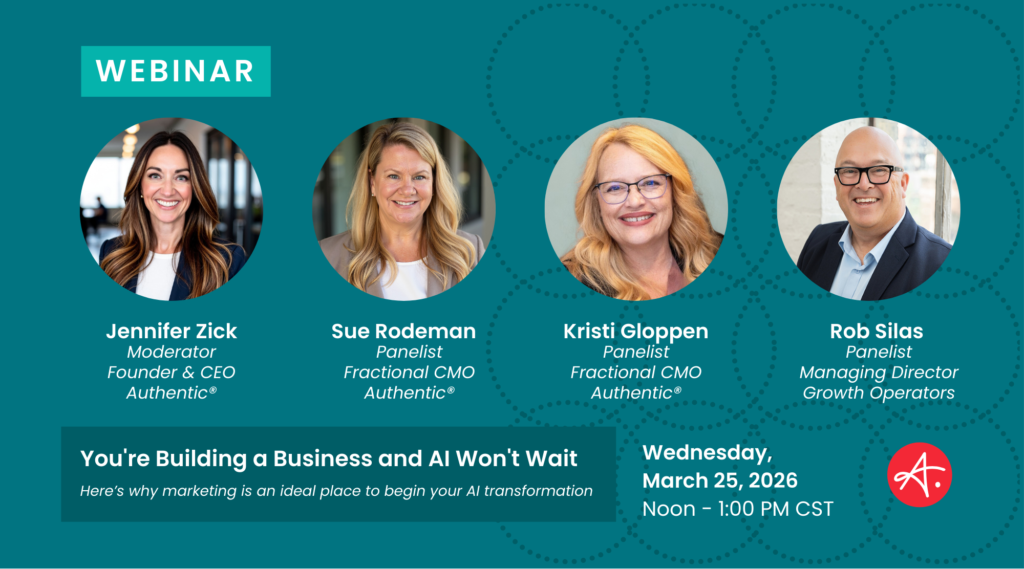
You’re Building a Business and AI Won’t Wait
Every CEO knows AI is reshaping the business landscape. But for many growing companies, the reality looks less like transformation and more like a team experimenting with ChatGPT as a search engine — without a clear strategy, a sense of what’s possible, or a trusted guide to help them get there.
The truth is, marketing is one of the most AI-ready functions in any organization. From content strategy and copywriting to design concepting, website wireframing, code development, system integration, and data-driven insights — the opportunities are enormous. But so are the risks of getting it wrong. AI without experienced marketing leadership can mean off-brand content, wasted budgets, and missed strategic opportunities.
In this 60-minute fireside chat, three marketing leaders—Sue Rodeman, Kristi Gloppen, and Rob Silas—share how they’re helping businesses move beyond the AI buzz and into real, strategic action.
Watch the Webinar
Key Takeaways
- AI tools can generate high-quality content rapidly, enabling marketers to produce more materials in less time.
- AI-powered searches are outpacing traditional search, with conversion rates 4.4 times higher than before.
- Active CEO involvement in AI experimentation fosters a culture of innovation and encourages team members to embrace new technologies.
- Marketers need to develop strong analytical skills to interpret data and derive actionable insights from AI-driven tools.
- Regularly review and adjust AI strategies to align with evolving business goals and technology advancements.
Webinar Transcription
Opening & Context Setting
Jennifer Zick: Nice. Okay. All right, here we go, folks. Let’s start. All right, welcome, everybody who is rolling into the Zoom Room for today’s authentic growth webinar. I see the participant number ticking up here, so we’re going to just let a couple minutes roll in so people can get through the Zoom hoops and get settled. If you are planning to be at an AI webinar, you are in the right place. So welcome. We’re glad to have you with us today, joining from all across the country, really and maybe beyond. This is going to be a great conversation with a room full of marketing and digital transformation experts. We won’t be able to cover everything today, but we hope we’re going to give you some really great nuggets, actionable ideas to take back to your business.
So as you get settled, I just want to encourage you to take notice on your screen of the Q and A icon. Use that if you have a question for any or all of the panelists as we go. I’m going to create space at the end of the webinar to take a few questions from the audience. So ignore the chat button and use the Q and A button. That’s where I’ll be paying attention as the moderator to any. Any questions that come in.
So I think we’ve officially hit a critical mass of attendees in the room. We’re going to go ahead and kick off because we have much to cover. So again, welcome to the Authentic Growth Webinar. I am your host, moderator Jennifer Zick, founder and CEO of Authentic.
For those of you who are joining us for the first time, I want to share a little bit about who Authentic is and why we’re here and who is attending and who’s in the audience and what we’re hoping to be able to cover today. So Authentic is a fractional CMO firm and marketing transformation firm. We help great growing businesses to overcome random acts of marketing and confidently take the next right step toward healthy, authentic growth. The clients that we work with all across the country are growth businesses. They’re generally between $10 million to $250 million in revenue across all types of business models and industries. And the CMOs on our team, including Sue and Kristi who are on our panel today, come to our team with really diverse and deep, true executive marketing backgrounds.
And it’s our joy every day to work with entrepreneurial teams to help them unlock the real strategic power of marketing in alignment with sales to drive growth. So that’s Authentic. And this Authentic Growth webinar series was born a few years ago out of my desire to engage with my own team and those in our network of ally partners and friends on topics that are important to business leaders today. So today we’re going to be speaking as if we’re at a coffee shop having this conversation and we’re thinking about the businesses we typically serve, which are those SMB businesses. But I want to acknowledge that in our audience today we have folks coming in from large enterprises, folks from mid market, folks from early stage startups, folks.
Some of you are owners, some are executives, some are growth leaders, some of you are consultants, some of you work in agencies. We have a really wide audience. And even though we’re going to speak from the position of serving executive small mid market teams, I hope that every single one of you attending today is going to learn something new or hear something that makes you curious to dig in deeper. So that’s our goal for today. We’re grateful to have you with us as we talk about the reality that we’re all facing. You’re building a business and I won’t wait with a specific lens on how marketing is a great place to start to leverage AI. So before we dive in, I want to take a moment to let the rest of my esteemed panelists introduce themselves one by one. Please share a little bit about your background, your current role and why you’re excited to be here today. And I’m going to start with our guest and my former colleague but longtime friend, Rob Silas.
Rob Silas: So much Jen, and thanks everyone for coming again. My name is Rob Silas. I am the managing director of AI and Decision Intelligence for Growth Operators. Growth Operators is a Minneapolis based firm. We are a full service back end value creation firm and what that means is we work with mid market private equity companies as well as mid market and lower mid market companies to help them primarily in their finance function and HR and IT functions. And with me being on board with AI as well to really help get them and get their backroom and processes in place so they can really accelerate growth. So we typically have consultants embedded that are doing a lot of great work with our clients in each of those different areas.
Prior to being at Growth Operators, I spent 30 plus years in the sales and marketing side and that’s where Jen and I go way back actually. And so and so before I joined Growth Operators last August, I built an AI product myself that I was using my sales and marketing clients. So it’s been a nice interesting sort of transition for me to see not only from the sales and marketing side, but also from the finance nature and business side. Happy to be here and really excited for the conversation.
Jennifer Zick: Thank you Rob. Over to you Kristi. Yes, hi.
Kristi Gloppen: Thanks everybody for joining today. I’m Kristi Gloppen and I’m the Chief Customer Officer of Authentic and as part of that role I actually do work for a few clients as CMOs, but then I do work with Authentic directly managing the sales and marketing and growth for the company. In my history, I have spent over two decades in marketing leadership, a lot of that in the tech and manufacturing space.
Jennifer Zick: Awesome. Thanks Kristi and Sue.
Sue Rodeman: Thank you Jen. Hi everybody. I’m super happy to be here today. My name is Sue Rodeman. I’m a fractional CMO for Authentic and have the honor of working with growing companies and helping them drive their marketing strategy and really help them achieve some of the goals that they have. So that’s been a lot of fun. Prior to that, I spent over 25 years in a variety of different marketing Leadership roles for B2B software Technology manufacturing companies. Throughout that experience, technology has always been a passion of mine, whether it’s because of the products that we sold or the way that we as marketers were using technology within the workplace. So this is a super exciting time and looking forward to having a nice discussion about it.
AI Application in Marketing Today
Jennifer Zick: Thank you all for being here together, your diverse perspectives teach me something every time I’m in the room with any and all of you. So I’m excited to learn today. And as I always do as the moderator of these conversations, I invite myself onto the panel to participate too. So I’ll chime in and be part of this conversation. So, Sue, I want to start with you. You are in the trenches with our clients every single day. Like you said, leveraging technology to innovate. And AI is the newest generation of technology. So for the CEOs who are listening, they know that AI matters. They’re not really sure where marketing teams are applying it right now. Where are you from? The front row Seeing the biggest tangible impact today?
Sue Rodeman: Yeah. Great. Yeah. So I think there’s a spectrum of examples happening today. So first and foremost, and what’s probably been used more pervasively over the last couple of years has been around content creation. Right. People and marketers in general are using it to create emails, write blog posts, create product materials. And at first, I’d say the quality probably wasn’t that great. People were very skeptical of what was coming out of the AI tools. But as those tools have gotten smarter, and I think more importantly, marketers have gotten smarter about how to use those tools, the output really is quite good. And as a result, you should be seeing efficiencies in how quickly content is produced, the quality of what’s coming out of those production engines, and then in turn, some reduction in external spend in driving that content as well.
So that was just the beginning, though. So I think as marketers are really learning how to train those AI tools, they’re teaching them how to understand what their brand should be, what their business goals should be. And as they start to do that, it’s really becoming a strategic tool that can help even design a campaign or analyze campaign data or other. Other parts of research. And so we’re definitely seeing that take shape more. And as a result, the product or the campaign or what’s being produced, the program is getting sharper, the quality is getting better, and things are getting produced more quickly, which is really great. Another benefit that I personally love. I’ve always been someone that loves to have that peer in the workplace that I can bounce ideas off of, that I can work through a problem together.
And I’m finding more and more myself and others included are using that AI engine as a. As a colleague or as another peer, someone that they can really work through problems. So I think that in itself is making us all smarter. It’s making our product better and, you know, really improving what we’re putting together. What’s most important, I think in that though, is that the role and the skills that the marketer’s playing is changing. Right. We used to be producers. Now you need not just creative people, but you need somebody that can be a critical thinker. And I think that gets even more important as we go into the next stage that we’re starting to see where automation is taking shape. And those agentic solutions that I think Rob will probably talk about really start to take shape as well.
So it’s not just about building content. It’s about how can I automate a process. So how can I more quickly, more accurately, more personally route the leads that are coming through the system as an example? So instead of having someone look at it or a system, do some basic if then rule reporting, you can get really smart about what did that lead look at, what are some of the challenges associated with that lead. Create something on the fly, more personable, more actionable right there and then. So it’s really exciting where this is all going.
Jennifer Zick: Absolutely. And we’re using these solutions at Authentic all around our marketing programs too. Maybe you want to speak a little bit about it. I think one of the latest blogs that we’ve published is a blog that you wrote, if I remember correctly, in collaboration with the AI environment that we’ve created for Authentic that helps to support our brand, our voice, but also elevate our CMOs unique thought leadership. So can you share a little bit about under the foot on that?
Sue Rodeman: Yeah, absolutely. So I consider that almost like a marketing assistant that we have now in our workplace. And so I went and started to write a blog and I had some ideas that I wanted to speak about. I wanted to speak about clarity and the importance of clarity within the marketing organization and the impact that can have on a marketing organization. But I also really wanted to tie it to how I see our methodology come to life in that vein as well. So I put together some of my thoughts, some of the goals that I had for it, some of the copy that I had already written about it.
And the block tool was able to take that shape it, align it to the methodology that we deliver to our customers and our customers on a daily basis, and then also really ensure that it’s aligned with the brand, that it’s aligned with any other kind of rules and perspective that we have when we’re talking about ourselves. And it did it in the nick of time. Like, it was absolutely amazing how quickly I was able to produce that, but it was still in my voice, which was certainly important to me as well, that I was able to retain my voice throughout it.
Jennifer Zick: Yeah, and I’ll just speak into that. Like, that blog could not have been written without Sue because it’s Sue’s wisdom, it, Sue’s thought leadership, it’s Sue’s experience through the lens of a CMO as being a true thought leader. But what that saves for us is the editorial process that used to take a human to like, interview sue, create something, draft it review cycles, make sure all of our IP is properly formatted and trademarked and all the things, you know, only just a couple years ago, we spent over $30,000 a year to create one blog a month with that kind of a manual intensive process. And there are so many companies rich with experienced thought leaders that have had such a struggle to engage. Like, how do we get our engineers and our architects and our brilliant people to be voices in our content?
Like, it’s never been less friction than it is now. And so, Rob, speak a little bit into this topic about. You’ve already been on. You are, you’ve always been a leader in the space of technology. You’re always paces ahead of the rest of us. So where are you seeing the application for marketing today and where do you see it, like, tomorrow?
Rob Silas: So let me talk a little bit maybe on the data side as it relates to marketing first. And you know, as we all know, AI gives us some tremendous opportunities to do analysis faster. And you know, in the time that Jen and I have been associated together, I’ve always been really passionate about how we get to the stories and the data, how do we, you know, how do we get to the narrative to make it easier for people to understand? And AI can really give us the ability to get there now like it never has before. So maybe let me give you a quick example. I’ve got a marketing client where we do a weekly, we do a weekly report and it’s always been just typically a weekly report. And we’re integrating data from HubSpot, Salesforce, Google Analytics and LinkedIn.
And so that report in the past, to put that all together, you know, would typically take after narrative and everything else. It would probably typically take a couple of hours to do that. Right. Well, now, today we can take all that data. And one of the things I think is crazy great about AI is that we can take the, literally the raw data from each of those sources and Giving cloud some instructions on how to look at it. It will, it will synthesize all of that, put it in a dashboard for us. So that’s created along with narrative. But the great part about it is even six months ago with AI, I would have to look at the detail on the campaigns.
It wasn’t doing a great job of pulling that in, but now it pulls the campaign detail data in, puts it into the narrative in context. And of course, as you said, Jen, you know, I make sure we QA it and we look at the narrative and that it makes sense. But it’s taken a couple hour process, literally down to like 15 minutes. And so, you know, and the shift that we’re all experiencing, of course, right, is that now the shift is data prep. You know, we don’t have to spend as much time on that. We don’t spend as much time on creation. It’s really looking at the narrative and that higher level critical thinking, like sue said, as well as making sure we’re spending time in qa. So that’s a bit of the shift.
But you know, the value for the client, of course is, you know, they’re getting things in a much more timely fashion and you know, frankly, just a better deliverable, you know, which is what we’re all, what we’re all trying to get to. And so I just want to give you all that example. That’s a very simple one, it’s a small one, but it’s a real one. And, and I will tell you that the capability of the tools, as we’ve probably all known, if you don’t know, you should know, has accelerated greatly since December. And especially on the data side of things, me being a data guy, I used to the ability to crunch numbers accurately. It was good, it wasn’t great. And now just in the last literally four months, that’s changed significantly in a very positive way.
So that’s just a kind of a current state example of where we’re at.
Jennifer Zick: Yeah.
Rob Silas: And so, I mean, in terms of where things are going to be in, you know, on this, honestly, I don’t think you had more than about 60 days. I mean, literally, because you can’t. Right? I mean, you just can’t. So I think, you know, sue touched on, you know, we’re going to see a wave of agents that’s already hitting us. Right. And that’s going to continue to accelerate. I’m not going to go into detail on that because we could be here for hours on that. But you know, that’s, that to me is certainly the thing that’s coming that we all have to really be aware of and be looking at how we can leverage those effectively and safely in a business context.
Jennifer Zick: Absolutely. And I’m going to move on to our next question very shortly here and that’s going to come back to you, Rob. So I want to give Kristi a moment to weigh in on this because Kristi, you’ve just recently in the last few weeks stepped into the CCO role for Authentic. And you’re still analyzing where we’re at with our existing marketing, with our existing sales process, all of that. But how are you thinking about AI in a small business like ours, supporting the small team that we have? That’s scrappy. How are you imagining that as part of the plan now?
Kristi Gloppen: Right. Well, you know, I know people, some people think AI is coming, right? And it’s going to change marketing quickly. However, AI is already here and it’s already changing marketing. And as marketers or growth leaders, we need to change our approach on how we are finding our customers. As an example, you know, traditional search this year will be down by 25%. That’s pretty staggering. And companies and marketers are not noticing this as they look at their paid search and their SEO and they’re like, what’s happening? Everything is falling off of a cliff. Right. And the industry is now saying that by 2029 searches on AI search engines or answer engines are going to completely surpass traditional search, paid and organic. And we’re already seeing this shift. This isn’t something that’s going to happen.
Right now more of our inbound leads are coming through an AI engine than are coming through a Google search or through paid search. So we need to make the shift and all marketers really need to make the shift quickly. You know, what I would say is with this falling off of the cliff of search metrics is a lot of companies are not set up to have a playbook to reverse that. And it’s really going to take digging into your content, digging into your web strategy and really determining how can I be found in this new environment where AI has grown faster than most expected. There are several reports too around why. Are inbound lead sources changing? And part of it is AI engines are really sending more qualified traffic to your website.
And so as that’s taking place, for example Semrush’s current research that they put out is that leads coming to you from AI are converting 4.4 times more than leads coming through search. And that goes back to what Rob said, you know, these platforms were pretty good but in the last four months they’ve really evolved and they’ve become pretty great. And a lot of folks are buying positions or senior leadership positions that are looking for partners, it is saving them a ton of time.
Jennifer Zick: Yeah, yeah. I can quickly affirm with a really fun little side story on that. And I can already tell you guys with our panel that we could spend a whole hour on one question here. And so I am going to keep us moving because this is so rich. But we’ve been tracking for the last year and a half leads coming to our website through AI versus traditional search. And I can totally affirm that trend line. The other fun and funny thing that happened is I’m working on a lead, a deal right now with an AI tech company. We work with many companies in tech and they found us, one of their partners found us through an AI search which is why he thought us to be so valid. So meanwhile their very CEO knew our salesperson and didn’t think about us.
They were finding us through AI which was the most trusted resource for their business. And so it’s, here’s the good news. There’s so much that’s possible right now. And here’s the bad news. Whatever you had in your content marketing plan 6 months ago needs to change. This is why you never have a marketing plan that set it and forget it or just run it. You don’t just run a marketing playbook. The world is changing too fast. And now I could give you a whole pitch for why our methodology is agile. I won’t go there now, but I’m coming back to you Rob, on this next question because you have always sat at this interesting intersection of marketing, sales, business, intelligence and now that’s expanding even in those back office functions.
And you’re building AI solutions for clients, but you’re also building AI solutions for growth operators and helping lead their leaders through that change. And change management is really the crux of what we’re facing right now. Overall, that’s the biggest picture. So can you walk us through what it looks like to drive AI education and adoption within the org you’re part of? What does that look like?
Strategic AI Adoption and Change Management
Rob Silas: Yeah, that’s a great question, Jen. So I guess first what I’m going to say to everyone is, you know, when you’re thinking about AI adoption, I think it’s probably just natural for most of us to look at it and say, gosh, we feel like we need to be moving faster, right? And you know, the reality is, no matter where you are in the spectrum, you’re not alone. And I’ll give you one evidence point on that. And some of you may have seen this just in the last week, OpenAI announced they’re going to just about double their workforce in 2026 in terms of adding headcount. And the, one of the primary reasons that they’re doing that is because they’re seeing that companies are struggling with adoption, right?
And so they’re dedicating a big chunk of their new hires to people that can help companies with adoption. By the same token, Anthropic who owns cloud, when they launched their cowork for enterprise product about a month ago, they did, you know, the typical launch in our webinar. They had three Fortune 500 companies on stage talking. And one of those companies very intentionally talked about adoption, which to me was having been around technology for a long time, to hear a technology provider in their launch talking very intentionally about adoption really resonated with me that, oh my gosh, they’re seeing that, you know, everyone’s having a hard time trying to figure this out, right? So, just to let you know, if those two companies are thinking about it, you’re definitely not alone.
So as you know, so as I think about adoption, as Jen said, we could talk about it for hours. So I’m gonna give you three buckets and maybe a little nugget in each of the three buckets. So the first bucket is, you know, obviously you’ve got, this has to start from the top. And we all know that’s, that’s true with anything. What I’m going to say here is the key is show, not tell, right? You know, AI is a, you know, a medium that’s the easiest to use technology that we’ve ever seen. And so for leaders to show what they’re doing and to show that throughout the organization makes a huge difference. And I’ll even just say growth operators. Our CEO Rick is, he’s clocked in creating stuff and he’s super excited about it, he’s showing people what he’s doing and guess what?
Then people get excited, right? So I know that’s very simple, folks, but it’s really, really important. And to take that the next level down, I have a couple CEOs that I talked to that have done something similar with our leadership team. So they’ve, they’ve asked their leadership team every week to allocate a chunk of time to doing work in AI and then at their weekly leadership meetings, they don’t just talk about it, they show it. Right. And so they’re showing their colleagues what they’re doing. They’re creating examples by doing that, they’re sharing that with the organization. And again, what a way to start to empower your team to say here’s what I’m doing. It helps the leader understand what’s possible, what’s reasonable. So those are again, I know, very simple examples. But to me what I’ve seen, very powerful.
So senior leadership buy in, show, not tell as we go the next step down from senior leadership. You know, how do we adopt across the organization? Well, again that’s a huge topic, so I’ll state the obvious. But again I’m going to ask you all to think about this very intentionally, which is you have to have a process. And so we have a seven step process that starts with understanding business outcomes first. You know, what are our measurables? We can make the measurables really simple because sometimes they can be sort of intangible. Then let’s go from business outcomes to use cases. Understand how technology layers into that, understand how the people side layers into that, which I think we’re not talking about enough frankly, right. From a change management perspective. And then governance comes into that as well.
We’ll talk a little bit more about governance, hopefully here in a little bit. So have a process, make sure you put a process in place and make sure that it’s grounded in business first. That’s absolutely critical. We can’t fall into a one dimensional tool. We love the tool. Let’s talk about the tool first. It has to be grounded in business and business strategy. And then the last thing is implementation. So you know, this is an area where it’s interesting. You know, we’ve, I’ve done a couple of really great strategy sessions with clients and we get done with the strategy session. The first thing they say is this is awesome stuff. I love what we’ve laid out and the priorities, but I have no one to do this, I have no one that can lead this. Right.
And I think for mid market and lower mid market companies, I seem to hear that pretty frequently. So it’s an opportunity to really think about how can fractionals help you, whether it’s a, you know, whether it’s a fractional CMO to come in and help you understand the business side of what needs to happen and marry that up with the technology to move things forward or, you know, the whole fractional chief analytics officer space is starting to grow for companies looking to do it organization wide. So. And whether it’s a fractional or not, you want to have someone in that role that does really have that understanding of the business, understands process, understand how different functions work, and marry that up with the technology.
Where I have to say I’ve seen some companies fall down is they’ve put people that are really technology first people in those roles. And they’re very smart people. But if you do that, you have to have them paired up with a strong business advocate, just like we’ve had to do in any transformation, but especially in this one. And I would suggest if you’re looking to put someone in that implementation role, look for someone that can start business first and pair them up with the technology expertise. So those are three quick nuggets for you. Again, a lot to talk about there, but that’s what I’m seeing that’s working and I think those are things that will continue to work.
Sue Rodeman: Awesome.
Jennifer Zick: Sue, I see you leaning in on this a little bit.
Sue Rodeman: Yeah. So I just wanted to echo and just really affirm. Love what you said, Rob, about show not tell. I think like we said at the start of the call, I think everybody wants to do AI or get on the AI train, if you will, but it’s hard for them to understand beyond. I think I can use it to be a search engine. How do I apply that in my business arena? And so I love that idea of show not tell. And I think that’s really what starts to then get the impossible imagined because then they can start to translate into, oh, you did that for you. I could probably do that for me. So great approach there.
Jennifer Zick: Absolutely. And that’s exactly what happened at Authentic. We started with a slack channel on AI like two and a half years ago with our CMOs sharing what they’re learning and seeing and touching. And then I sat down with one of my CMO thought leaders at my conference table and said, show me this custom GPT that you built. How did you do it? Like, it felt like, so, like, I’m not a coder. How do I do this? She showed me just the starting page and I’m like, oh my gosh, I get it right? Like how to build this thing. And then the system taught me and I locked myself away for a couple days and started transforming several of our processes, but thinking of it from a business mindset.
And then I started to recognize not everybody in my business is going to be a self learner by just putting their hands on it. So we did invest in some training and education for some of our key leaders because everybody’s got a different learning style. Like how do you bring people along? You can show and tell or you can teach the fundamentals, but you gotta understand the learning styles of the people around you that you’re asking to take the baton and carry it into the business. All right, I am going to move right along into our next question. And Kristi, this one is coming to you. You recently shared some pretty eye opening data about how, and you just already touched on this, about how buyers are finding companies and what’s about to change and is already changing dramatically.
AI’s Effect on Buyer Behavior and Marketing Strategy
Jennifer Zick: So what do CEOs need to be paying attention to right now about how AI is reshaping how their potential buyers find them?
Kristi Gloppen: Well, I think there’s a couple things. The first thing is AI does allow us to accelerate research, to accelerate our planning, all of those pieces and to get to insights for faster. However, what CEOs need to think about, especially in small and medium businesses, is you need to have the right talent sitting in that senior level marketing spot to be able to take that insight and convert it into strategy and action. And that’s where we’re seeing the biggest gap within our customer base, is that they don’t have that senior talent that can sit alongside the CEO and build that future growth engine.
You know, so what we’re seeing some of our clients do is some of them are actually keeping their fractional CMOs longer so that they have that thought leader and they have somebody that can take those insights and help convert them into the strategy so the company can grow faster and surpass their competitors. Because it’s very easy to get that competitive research by asking the right questions to an AI platform.
Jennifer Zick: Yeah, well, AI is definitely having an impact on our business model for a couple of reasons. First of all, when I first started in marketing, to date myself like 25 plus years ago, there were only like 5 tools in the marketer’s toolbox. It was like trade shows, catalogs, you know, print advertising, creative, whatever, simple. And then the Internet was born right around the same time and the world began to change and change very quickly. And marketing went from being a creative discipline to being a data driven discipline with creativity. So those of us who are now CMOs who lived through all the Generations of that have always been digital transformation forward. This is just the next chapter of that.
And so we are growth leaders with a digital transformation mindset, which puts us in a real hot seat to be the thought leaders bringing our clients forward on these. And I’ll also say that in terms of what the CEOs are thinking about, I’ll speak as a CEO who’s thinking about this, like, how does this change our lead gen demand gen sales process? Now we’re a B2B professional services firm. A lot of opportunities come to us through our high trust referral networks. That’s just human chains of connection that AI is not necessarily impacting, but 30% of our deals and our revenue has come traditionally through inbound and that’s changing very quickly. And my first gut instinct with the AI tools 612 months ago was to see how easy it is now for us to create more thought leadership.
And that changed quickly when it’s like everybody can create more thought leadership. That is not the edge here. The edge is to understand how these new solutions read our content and find us and prioritize our see us as legitimate resources. And the formula for that. And even the platforms through which that’s happening are different from the machine we’ve been feeding all this time. And so this is why I’m saying if your marketing playbook has relied on a traditional content marketing strategy and you just want to throw more at it or put more dollars to buy more leads, that’s just going to be a fast track to spending more money and driving up your cost of acquisition. Like we all need to be rethinking acquisition strategy right now.
And this is why I’m so grateful for the model behind Authentic with our Mindshare of CMOs to it together. So nobody is getting stuck. But these pivots have never needed to be made faster and more thoughtfully because you can’t just stop everything you’ve done until you figure out a perfect plan. You have to start turning the dial. And we’re turning the dial without knowing what the world is bringing to us next. So it’s an exciting and crazy time out there, that’s for sure.
Kristi Gloppen: Absolutely.
Jennifer Zick: So Sue, over to you. Oh, unless. I’m sorry, I didn’t even pause. I jumped in and took the helm on that. But is there anything else, Robert sue, that you would want to weigh in on that one about? Like what’s on the CEO’s mind in terms of, you know, brand awareness and what’s changing.
Sue Rodeman: I mean, certainly, I think that using the word Authentic, right, the need to stay authentic in what we’re doing is a guiding principle, which is super important. And I think people question, but like I said before, I think the quality of what’s getting produced is so much better and it really becomes a voice of our own. So that starts to get answered there and then I think it’s really evaluating what is that change? What does that change in terms of my workforce? Like, what do I need within the organization? Does it change the profile? Does it change the structures? I think that’s another big question that’s weighing on CEOs’ minds.
AI’s Impact on Marketing Talent and Organizational Structure
Jennifer Zick: Absolutely. So, Sue, continuing on with you’ve talked about how marketer, the marketer’s role is evolving from creative production to critical thinker, evaluator. There’s a temptation right now for business owners to think AI means they can go lean one of two directions. Like, I’m talking to people who think, well, I no longer need an expensive senior marketing leader because AI can just build our strategy. And then others who are saying, we don’t need any, you know, early stage career people because all the production can come out of AI. So how are you helping leaders discern, like, how does this impact talent and what is the right approach to understanding those opportunities and impacts?
Sue Rodeman: Yeah, great question and not an easy one to answer. Right. There’s definitely not an easy button with any of this. But I think first off, the need for people isn’t going away. I think it’s the need for the roles that they’re performing and the way that they’re approaching their job. And so that’s why, like as you said and I said a little bit before, right, it used to be a creative function. Marketing was viewed as a creative function. Then with the onset of technology, certainly that became a more important role of the marketer. But now I think I can’t underscore enough the need for creating critical thinking at every level of marketing because it really is not just creating the content, it’s evaluating it right at the CMO level.
Then it’s really being able to look across that organization and continue to polish the way we play that role as orchestrators. Right. Because it’s always been how we bring all the functions together to work together and be the most effective. But as that’s pivoting, the way that those roles work together need to change and the skill sets that the teams need to have need to change. So I think it’s really understanding the talent that you have and bringing together the critical thinking, the technologists with the creative minds to bring the right ideas and the right strategies to the marketplace. And then at that senior level really being able to tie that into what is the strategy, what are the goals of the organization and how do I bring those functions together. So still incredibly critical.
You know, maybe there’s efficiency, there’s absolutely efficiency along the way, but I think it means that the quality of the work being produced is better and the speed that the work is being produced is faster.
Jennifer Zick: Absolutely. And I want to use an analogy that I heard from a panel that Rob was on at the association for Corporate Growth just recently. I don’t recall which panelist was sharing this analogy, but it’s so true that in the like late 70s or early 80s, whenever ATMs appeared on the scene, the prediction was that bank tellers roles would be wiped out because now there was just a machine you could go to get cash or to deposit cash. But instead we have more bank tellers now than we had then because their role shifted in the customer experience and was able to provide something of greater value in a different format than they did before. And in the same way professionals in the workplace are going to be needed around all kinds of new jobs that don’t yet exist.
And I want to, I wish I had it pulled up right in front of me but. Nancy Lyons, who’s a brilliant entrepreneur and tech advisor leader in the Twin Cities posted I think just today some statistics that I’ll probably get completely wrong. But they’re pretty eye opening about companies making plans to cut such significant percentages of their labor force this year in anticipation of AI efficiencies. And yet the current data shows that employees are reporting more inefficiencies than ever because I think it was like 346% less efficient because I think because we’re all trying to learn how to approach new things while trying to implement them while trying to run our current jobs at the same time. Like we are not there yet where the promise of efficiency is yet the reality.
And so I think some businesses are making short sighted decisions about cutting investments in staff rather than developing the staff that they will need in their business for the future. And the other thing I think that is important to recognize and I’ve been really thinking about this as a mother of college age students, one that’s graduated, one that’s in the middle of college, One that’s in 10th grade is what is the relevance of a traditional university education right now to prepare students to enter tomorrow’s workforce. And I think it’s important that as business leaders, we recognize that traditional universities will take time to catch up. Just like I remember what the universities were teaching in digital marketing when I was practicing it. And I’m like, the gap was so huge. Right. Theory versus reality of how fast things change. That’s happening right now.
And we need to be ready to hire young people and train them quickly on technologies they’ve been told are banned and scary and not to use at all during their educational journey. Right. So I just went on a whole tangent there. Any other thoughts around the table on this in terms of staff and resources?
Sue Rodeman: I definitely agree on your perspective on college, Jen, but I think there’s a. I think it’s similar to organizations that are still fearful of AI, right? And they don’t want the AI tools for whatever reason, lots of them good to be used within the workplace. But at the end of the day, people are using those tools one way or another. Right. They’re using them to support their functions. So it is really critical that organizations start to build a strategy around it. The guidelines around it standardize on tools where they need to. And I think that’s an important role for the mark, the CMO too, to have a really big seat at that table to help drive what some of that governance and that strategy and that application needs to be.
Jennifer Zick: Absolutely.
Rob Silas: If I could just weigh in a couple things quickly. I think one that I don’t see a lot of conversation on and it’s a little bit of inside baseball here if you’re close to the tools. But one of the biggest considerations you have to make if you’re looking at making significant job cuts and lily replacing roles is the cost of using AI as a replacement for that role. And so one of the ways that, one of the primary ways that the frontier tools, you know, get revenue is through what are called token costs. And just think of token costs as essentially a kind of API transaction cost back and forth. So when you go to replace a role, maybe that person is using AI in the role, they had a certain level of volume and that was affordable.
But if you completely replace them, those transaction costs are going to go up significantly because you’re going to be relying more on AI. And we all know as we look at the financials of the frontier models, especially OpenAI and Cloud etcetera they’re all upside down. So I expect that we’re going to see token costs go up over time. So my point to all of you is if you are considering, you know, downsizing and replacing with tools, please be sure to run some scenarios on just what can happen from a cost perspective in doing that. And I think that’s something that, you know, it’s easy to throw platitudes around and say, yes, we can cut bodies and we can grab a bunch of subscriptions will be good. It’s not true.
So you really need to take those considerations into place and take that obviously very seriously. I think the last thing I’ll just say on job displacement is, and I’ll be a little bit of Debbie down here maybe. I do expect that while I’m bullish on what’s going to happen in the longer term, I do think we’ll probably see some pain in the shorter term. I think that’s just a reality. It’s an unfortunate reality. But, but it is. But at the same time, you know, we all have to, we all have agency. We all have to make sure that we’re doing what we can to know how to use the tools and add value and know how to, you know how to position ourselves. With that being the case, I think longer term we’re going to see it.
I just think it’s going to take some time and we may see some, we may see some displacement in the short term.
Jennifer Zick: Yeah. Thank you for those frank perspectives. It’s fascinating to think that we’re all getting hooked on the free to, you know, low cost version of what’s possible. It’s like we signed up for the free trial practically. But reality is coming. It’s coming. Yeah. So thank you for that. That’s so important. And Rob, you and I and all of us in this meeting, we have all, we’ve all lived long enough to have experienced many iterations of technology transformations. Right. I already kind of referred to that, like what marketing looked like before the Internet was born and after the Internet came, you know, mobile and social and marketing automation and all of these tools that promised to like, you know, radically change the way that consumers and business people buy. And they did.
But at every one of those cycles, you know, I also, I was selling marketing and technology and services around that. It’s like every single time we go through a new innovation cycle, somehow CEOs and business owners think this is the magic easy button. Now all of a sudden, this is it, this will be it. And I’m seeing that for sure right now. So, Rob, what’s the advice that you would give a CEO who wants to move fast, but from where you’re sitting, like, how do you move fast without going off the rails and being delusional about this being some kind of easy button?
Leadership and Team Dynamics During AI Transformation
Rob Silas: Yes, as you see, we have outlived that and we’re living it now more than ever. And I think largely because AI is just so easy to use and access. Right. I think we can think that it’s easy, you know, if you want to move, if you. In order to move fast and to not go off the rails again. I’ll state the obvious kind of threads you’ve heard me talking about all throughout the panel here, which are the foundations that have always been true through these transformations. They are still the foundations, right? So it’s start with business, start with strategy first, not technology first. You know, you have to take into consideration people, process and technology in equal weighting, you know, don’t be overweight on the technology side of it.
And the reason that those foundations are even more important now is because of what’s different now, right? And what’s different now, as we all know, is the pace of change is crazy, right? It’s ridiculous. But you need to have those foundations, you need to have those durable things in place. So kind of the analogy I give is this. If you think about AI as kind of sitting in the middle of a circle, right, we know that’s going to continue to change, and it’s going to continue to evolve. So what you need to have around that as sort of your wrapper around that, those are the foundations. And if you have those foundations in place, knowing your processes, knowing how your processes may change, I think the other thing that’s huge with AI, as I think we all know, is just context.
So what’s the context? What’s the internal knowledge in your company that you can capture and use to create that wrapper, create that moat around the AI that adds to what the AI is outputting. So it’s not just AI’s output, but it’s specific to your organization or even to your people. You know, you can create skills in any of the tools that are specific to a person that they, you know, they can do their work and apply the skill to it to get that more personalized, you know, more valuable output. So those foundations are so important. To wrap around it. So that’s, you know, that’s the other thing I would, I would tell folks. And just quick, if you want a playbook, here’s a quick little playbook for you. Of the things I’ve already talked about.
Let me highlight three or four of them. If you want to get up and run fast, I think you need to have one again, start at the top and show, not tell. That’s hugely important to get people excited. The second thing is, as we think about adoption in the organization, start with identifying use cases. You can do a quick little four quadrant on business impact and effort to implement use of that. You can do that quickly to map out use cases and understand the technology and grab any of your technology people, they’ll be able to tell you how they can map to those different use cases so you know what to apply, where and where to start. And if you’ve already started, you can start to look at one of the things we need to do next.
I think a lot of the hype that’s been out there about how pilots have not turned into production is true, but I think that’s changing with the change in the models. I think we’re going to see those cycles really compress and that you can get from pilot to production easier and faster. So it’s those two things for sure. Don’t ignore the people’s side as we talked about. Jen, you mentioned that in the change management side, I think it’s just, it’s so critically important in any change management thing that we meet people where they are. And Jen, you touched on that a little bit earlier. But we need to understand the skill sets that our people have.
We need to understand, you know, their bandwidth, their skill sets and their, and their motivation and apply accordingly and put them in a really easy way to have success early because I think we’ve all seen when you use this and you have success, then you want to do more, right? So that’s the people’s side and then governance and we really haven’t talked much about governance. I’ll just say with governance you need to have a layer across the organization. That’s the kind of, hey, dummy stuff that we know we need to have that we can’t screw up that goes across the Org and then when you look at use cases, you may want to have another layer there just depending on the type of use case if you want to turn your governance up or down.
So that’s how I think about governance and getting that in place quickly, those are really kind of the key things if you want to get up and run fast. Right. And. And remember, and we all mentioned, this really isn’t about an easy button. The success of this is not about an easy button. It’s about a discipline button. Now, I mean, that’s, to me, what it is. So.
Jennifer Zick: Yeah. And that’s where senior leadership becomes so imperative. The discipline to manage the pace, the expectations, the order of priorities, and the judgment to apply that within the context of your business landscape, and what’s important to the stakeholders around your business. So, sue and Kristi, I’m going a little off script here, but I would love to hear from each of you. You sit at that intersection as a trusted advisor and a member of our client leadership teams, and you’re holding the ankle of a CEO over here and holding the hand of the marketing team members and agency partners over here, and you’re working through change. And we’re all facing change at a velocity that’s faster than we’ve ever felt before.
So, Sue and then, Kristi, what are you asking of or needing from your CEO and C Suite colleagues to be an effective CMO right now? And what are you asking from the people that are part of the marketing team?
Sue Rodeman: Yes. So I think in some cases, it goes back in both places to a philosophy I have around taking risks and failing quickly. Like, you have to have the environment in place where we can iterate, where we can try new things, but have the grace if we need to fail and fail quickly, learn from that and start again. So I think that’s something you need from both. Right. You need that from your CEO, that willingness from your CEO, but. But then also that same kind of acumen and independence from your marketing team and your agencies as well. I think it also goes back to. At the CEO level. I love how Rob laid out that quadrant.
I think as we’re thinking about where we want to apply this, we need to be aligned on what is the biggest benefit, what type of impact can an innovation have and get that support then at that CEO level to try to tackle those sorts of projects, but also then do it at a pace that allows us to keep the wheels running so that we aren’t burning out and spiraling the teams that are making a lot of the magic happen, for sure.
Jennifer Zick: And Kristi, what about you? What are you asking of your executive leaders and your marketers in this time of change?
Kristi Gloppen: First thing is that this doesn’t happen overnight. It takes some time. And so I ask for patience as we work through it. Just like when you hire a new employee, you need to take time to train that employee and get them up to speed to really understand the company. It’s no different with AI. You’ve got to train it, you’ve got to get it to a place where it understands your company and that doesn’t happen overnight, that takes time. And in order for that to happen, you have to have the content and the information that you can give it. So it does have a true understanding. And quite frankly, some of that foundational work at companies isn’t done yet. Right.
And so it, you do need to have foundational elements in place, you need to have your brand guidelines, you need to have your processes documented, all those pieces so it’s not jump into AI right away and it’s going to work perfectly. It’s going to be a process to get there.
Jennifer Zick: Yeah, that’s absolutely true. And I can speak from the seat of a founder, owner, or CEO to say some of the things that I know CEOs are wondering about because I’m talking about it in all my CEO peer groups. And I feel this, okay, last year when we made the investment in company wide AI, we, you know, the horse that we Bet on was ChatGPT because they were in the lead on that race last year, right. And I told the team and I told my leaders as I was investing in their training, I’m like hold loosely to this particular platform. We’re in the AOL era of AI right now. Right now. And we’re going to go through many iterations before a front runner emerges.
If a front runner does emerge and at the same time that these systems are racing for the lead, all of our existing platforms inside of our businesses, whether like us, you run on Google or you run on Microsoft or you’ve got certain finance platforms, whatever, they’re all embedding AI within their systems as well at different paces with different functionalities. And so I’m trying to balance this teeter totter of what’s my philosophy about my tech stack right now? Because I just added to my tech stack to bring AI on. But I also am experimenting with a my with Claude over here and other solutions over here. And as a small business I can’t just like roll out every version of everything to everybody on an enterprise scale. I have to do it thoughtfully.
And so I’m sitting in a seat going do I wait for a skip generation and stay with chat with everything I’ve taught it about my business or Do I bring everybody over to Claude and I bring all of that knowledge into a completely different environment because it’s got new features, or do I wait till the next. It’s a hard time to be a business owner and to think about your tech stack investment and the change through that process and bringing everybody along on change.
So maybe I just say that to commiserate with the other business owners and CEOs in the crowd to say, if you feel overwhelmed, if it’s keeping you up at night wondering, like you’re already running a business that still needs you to run it, when are you going to like I feel like I need to lock myself in a closet and figure out how to build an agent right now, right. And then show the team like, these are the real things that are keeping us awake at night. So I just want to let you know you’re not there alone in all of this change. That’s why we’ve created this webinar today. And this series of webinars is so that we’re doing this together. We’re learning together at Authentic. We believe in mindshare.
We really believe that we’re all better and stronger together and we have a spirit of abundance. Like, we don’t want to hold back and be gatekeepers. We don’t want to try to charge our clients five times the fees for what now takes us, you know, that much less time to do. We want to give them the benefit of the efficiencies we’re finding. We want to innovate and be on the front end of this together and bring our whole community, all of you who are watching today, along with us. So many of you watching could teach us a few things. So we’d love to hear from you too.
Audience Q+A
Jennifer Zick: But with only a few minutes remaining in our time together, I want to turn it over to the audience where I see a couple of questions have come in.
I’m going to start with this one from an anonymous attendee who says, Rob, good points on AI not being free. So how does one estimate the cost when implementing AI to complete a function? We don’t really know how many tokens or transactions that would be required. So I’m not sure how to estimate that.
Rob Silas: Great question. I don’t know either. But I’m just telling you, like in my business, the process, we’re modeling it out. I mean, it’s just like modeling out anything. El right is if you’re not sure, you know, you take your best guess. I’m, you know, so in my world, I’m looking at, you know, for our consultants and for the ones that have used AI, you know, looking at usage patterns, just estimating how much time, you know, we’ve saved in certain, I have some data on that. I don’t have data on other pieces, so I’m estimating some of it. You know, the other thing I’m looking at too is, you know, where this gets a little bit more in the weeds is does there’s a cost for different models?
Even within Claude, we’re big Claude users, so within Claude there’s, you know, there’s different models and do we use different models that have different token costs for different tasks. Right. To save us money. And also with Claude, we’re going to buy some subscriptions and run some through the API and do both. And so there are, it’s a great question. There are a number of factors to take into consideration. I would just say, you know, do the best you can, estimate where you have to with best guesses and run scenarios. You know, say here’s a, here’s a worst case, here’s a best case and there’s a middle case. That’s the best we can do right now.
Jennifer Zick: Yeah. Or like let’s ask Claude. Hey Claude, how much are you going to cost in the future?
Rob Silas: Right, right. Well, Claude created my whole model for me, so now I’m just filling in the numbers. So.
Jennifer Zick: Yeah, yes to this being a great question. All right, another question for the panel. Building on Jennifer’s point about prior innovation cycles in marketing with Will AI adoption be driven more. This is a predictive question again, will AI adoption be driven more by best in class point solutions like Claude Chat those or by platforms that integrate into existing Martech stacks like the AI that HubSpot’s building out and the AI that is part of my Canva and all the other things that we’re using. Any thoughts on that? Predictions? Who’s got a crystal ball here today? I should have one on my desktop.
Kristi Gloppen: I think it’s a really challenging question. Right. But in order, what AI put in your current tech stack and your current tools like a HubSpot is there for a very specific purpose to get more value out of HubSpot and to allow you to better at your targeting and whatnot? Unless they tie to the databases of where all of the content is living. Right. They won’t be able to do everything right. So from a research standpoint, I really do think that you’re still going to be using that external platform, not one that sits inside of your current tech stack.
Jennifer Zick: Sue, do you have any perspective on that?
Sue Rodeman: Yeah, hard to say, but I asked where I was going to go as well, that I think it’s going to be a combination of the two because I think you’re not going to want to recreate with your custom GBT what HubSpot can do within its systems. But there’s always going to be things that are going to be unique to your organization or maybe cross types of systems that would require a custom, call it GPT or Claude for yourself. So I believe there’s going to be an element of both. But I do also believe what is embedded in those enterprise systems is going to keep getting better and, and broader and broader as well.
Kristi Gloppen: Agree.
Jennifer Zick: And you got to believe those enterprise players are going to move as fast as they can to protect their turf and make sure that they don’t lose to other AI enabled solutions. And so from my seat again as a business owner, looking at our Martech stack and our general operating tech stack, it’s going to get more expensive before it gets more efficient because we have to keep the legacy tools because they run our business today and we need to layer on innovation tools and figure out where they fit. And right now those innovation tools are basically starting to pick up a lot of what I used to have to custom figure out in spreadsheets and in documents. They’re not replacing my CRM, they’re not replacing my payroll system, they’re not replacing G Suite as our central organizational structure.
Jennifer Zick: They are amplifying our ability to do the work that we’ve done as professionals in spreadsheets and documents and be more efficient in those kinds of functions and roles and then learning how to use the other tools and get out of them what we need. So I think this is going to get more expensive before it gets more efficient and nobody is going to be able to stay on, I mean, staying on the leading edge right now, staying on the bleeding edge. You’ll be the one taking all the risk, putting in all the costs to stay on that edge. Like I always try to run my business from a, you know, early adopter leading edge, not the bleeding edge. Learn from the people who are going out in front of me and then try to embody as much of that best practice as possible.
This hour has flown by and I don’t have more time for questions from the audience without running over. So we’re going to go ahead and gently land the plane right here. But I know that any of these panelists whose names are on this screen would love for you to reach out to them via LinkedIn, via Authentic’s website. For our team, if you have specific questions and you’re looking to tap into the mind of an expert in a specific area here, we would love to help. We’re here. We’re better and stronger together, and we’d love to be a partner with you on that journey. And I know we’re Rob and his team feel the same. So thank you so much for tuning in.
Today we’re going to run this series with two more upcoming webinars on AI related topics, bringing in perspectives from other CEOs and perspectives from the tech makers that are on the bleeding edge making it come to life. So you won’t want to miss those two events coming up soon. For now, go forth, be awesome, shine your light, be a blessing, don’t lose hope. We’re going to do this together. It’s exciting. All right, I’ll see you back for the next show. Take care, everybody.