The CEO’s AI Dilemma
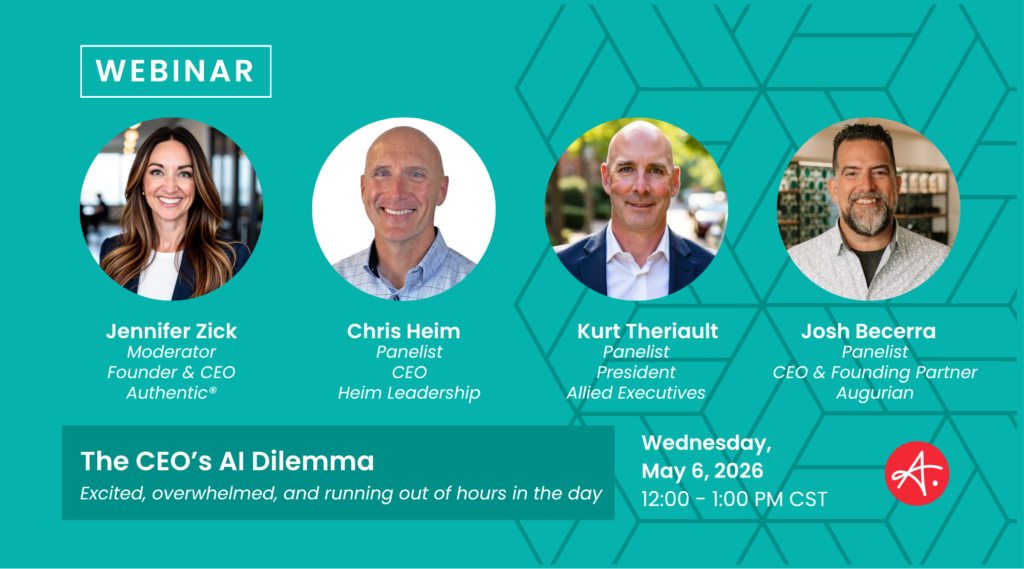
In this Authentic Growth® webinar, Authentic founder and CEO Jennifer Zick is joined by three executives, Josh Becerra (CEO, Augurian), Chris Heim (three-time CEO and consultant), and Kurt Theriault (President, Allied Executives) for an honest conversation about the real-world challenges of AI adoption at the leadership level.
The panel covers where each leader currently stands with AI while addressing the emotional rollercoaster of excitement, overwhelm, and FOMO that comes with it. Key themes include how to make smart technology investments without over-betting on any single platform, the importance of starting with education before automation, and why human judgment remains essential even as agentic AI matures.
Watch the Webinar
Key Takeaways
- Ongoing experimentation is essential for refining AI processes and understanding the optimal integration of AI within existing workflows.
- Begin with education, then simple tools, progressing to automation while managing corporate data carefully.
- Human-in-the-loop strategies and training programs are essential for quality, clarity, and managing overwhelm.
- Continuous training and focused projects help prevent burnout and maximize organizational impact.
- Leaders will need to focus on emotional intelligence and interpersonal skills to maintain team cohesion and morale in an increasingly automated work environment.
Webinar Transcription
Opening & Context Setting
Jennifer Zick: All right, welcome. Welcome everybody to the Authentic Growth® Webinar. We’re just opening up the Zoom Room and letting everybody come in, so we’re going to give a couple of moments to let folks settle. As I watch the participant numbers start to rise. If you had expected to be joining a webinar on the CEO’s AI dilemma, you’re in the right place. I’m so excited today to introduce you to my esteemed panelists and friends and to have this candid coffee conversation with these executives and help you all feel validated about the life you’re likely living right now in the swell of AI. If I haven’t met you before, my name is Jennifer Zick. I’m the founder and CEO of Authentic®.
We are a fractional Chief Marketing Officer firm that helps growing businesses overcome random acts of marketing and confidently take the next right step toward healthy growth. On our Authentic Growth webinar series, we talk about growth from every angle. Not just marketing, but all of the levers that have to work together to create a healthy, thriving business that can grow sustainably. And today the topic is, I mean the topic of every subject lately, AI. We are going to take the spin on it to help speak to the world of the CEO. But I also recognize that a lot of you are joining from other seats and other roles in the organization. And I do believe you’re going to get a lot of value out of today’s conversation as well.
So it’s our aim that all of you take away some nuggets that are going to be helpful in your world. And of course, we’d love to include you in this conversation today. So please notice that at the bottom, it should be at the bottom of your zoom screen there is a Q and A function. I’m looking for it right now. I see at least the chat function. Maybe we didn’t have the Q and A enabled, but if you don’t see that, use the chat. I do want to make some time for questions from our viewers today, so without further ado, I’m delighted to take some time to introduce or let our panelists introduce themselves. And I’m going to start with my friend Josh, who on my screen is right below me. Josh, tell us who you are. What brings you here today?
Josh Becerra: Awesome. Thanks, Jennifer. So my name is Josh Becerra. I’m a founding partner and CEO at a company called Augurian. So we’re a digital marketing agency, helping our clients have confidence in their digital marketing investments, primarily focused on paid media, SEO and analytics. And of course we’ve been diving into AI and I’m excited to have this conversation.
Jennifer Zick: Oh, I’m excited for your perspective because the world of SEO is changing pretty quickly. So thanks for being here, Josh. By the way, friends, I did find the Q and A feature. For me, it was buried under the more button, so find your way there. Make sure you share questions as we go. We’ll make time at the end. Next, I’m going over to my friend Chris. Hi, Chris.
Chris Heim: Jennifer, hello. Hi everyone. I’m so excited to be here. Quick, for me, I’ve been the CEO of three different companies, two family owned companies and a private equity backed business, technology focused. I’m currently doing some consulting focused on business strategy, leadership and this wonderful topic of AI.
Jennifer Zick: I’m so excited to have you here. Chris and I are on the same CEO roundtable together and he’s just a great peer. And then my friend Kurt, who leads another peer group that I am part of that I love, Allied Executives. Kurt, introduce yourself.
Kurt Theriault: Yeah. So, Kurt Theriault, President of Allied Executives. We’re a high accountability peer advisory organization here in the Twin Cities for leaders who carry the weight of company performance on their shoulders. So they’re placed in right fit groups matched to the stage of growth that they and their company are in, holding the written commitments and challenges with real candor. So we get about 180 plus CEOs, presidents, various titles, but all are folks who are, you know, like I said, charged with being the strategic operator of their business. Yeah.
Jennifer Zick: Well, thank you so much.
Kurt Theriault: Thanks for having me. This is a hot topic and I’m happy to contribute whatever I can.
Jennifer Zick: Absolutely. I’m excited because you can speak from the experience you have directly and the CEOs you talk with and their leaders every single day. I’m so grateful to have friends like all of you that I can have these candid conversations with. And I have to admit that when I decided that I was going to do this three part webinar series, this was the webinar topic I wrote as kind of a therapy session for myself. So you didn’t know it, but you’re all here to hold my hand through this wild ride of AI innovation. I’m excited to dive in and talk about it.
And my hope is that everybody who’s listening in today is going to leave excited, empowered, affirmed, not afraid of what’s to come, but excited to know that we’re all in this together, we’re all figuring it out together and we get the opportunity to share with one another as we go. So speaking of, we’re in this together. I want to start the conversation off. Josh, I’ll take this first question to you.
AI Adoption and Current State
Jennifer Zick: In a sentence or two, how would you describe where your company is at right now and where you are at right now with AI? Not where you want to be, but where you are today?
Josh Becerra: Yeah, well, it’s been a journey to say the least. You know, the company has multiple subscriptions to a bunch of different LLMs. OpenAI, anthropic. Our team is kind of leaning towards Claude right now. Anthropic’s Claude. We’ve also built OpenClaw agents, so we’re experimenting with some kind of semi autonomous workflows and deliverables. I wouldn’t say they’re ready for prime time. So I guess there are lots of kinds of sandbox activities. And I think more than anything, we’ve started to understand that context. Like, we have lots of clients, so that client context is what’s most important. So kind of the better context that you can give us, agent or LLM, the better the output, obviously.
So we’re in the process of building some kind of private and secure infrastructure that’s going to help us capture that context so that AI orchestrators can use it and be kind of a teammate for my team. So I’ll stop there for a second, but lots of activity, lots of experimentation, sandboxes, and then a clear focus on building this private and secure infrastructure.
Jennifer Zick: Amazing. All right, thank you for that. Kurt, what about you? Tell me a little bit about where you’re at in your organization with AI.
Kurt Theriault: Yeah, happy to. I think I’d sum it up as we’re on a steep learning curve. Everybody’s at a different stage of diving in. We’ve definitely invested in some training, and participated in that just to get a foundation. Okay, what are we dealing with here? And just get the basis in place. We’re making targeted progress. The way we’ve decided to attack it is really kind of to take a step back and say, what problems are we trying to solve first? Right. It’s kind of AI kind of feels like a nine pound hammer right now and trying to pause and just wield that thing everywhere. So we’ve just dialed it back to three work streams that we’re focused on. One is in the sales and marketing space. So how can we amplify the speed and the quality of what we’re doing there?
Lowering the administrative burden. We’re a very administrative heavy organization. So, you know, what can we use it for? To help us simplify that and remove some redundancy that’s being created as we’ve grown. And then the member experience is the third stream. So how can we augment that and improve that? Through the use of some tools that we’re building organically for our members to be able to use to, you know, like I said, enrich their experience. So. But we’ve had to take a step back and say, okay, even though we’ve narrowed this down to three kinds of areas where we. We want to solve some things, we’ve decided to just really focus on one project, or one rock, if you will, per quarter, and just feel like we’re getting some W’s instead of just spreading it really thin. So.
And that we didn’t start off with that clarity. You know, we definitely were wielding the hammer early. Now it’s like, let’s put that away and be a little more targeted. And so I feel like we’re making good progress. But, yeah, the curve is steep. So steep. So. But that’s. That’s probably how I’d sum it up.
Jennifer Zick: I appreciate that intentionality. And it does feel like we all jumped in to run a marathon we didn’t train for. So now we’re like, all right, how do we chunk this out?
Kurt Theriault: Well, right. You know, I think we all. In the beginning, I mean, everything you heard was, hey, if you’re not, you know, advancing in the AI space, I mean, you’re getting passed by. Right? And I think reality is cars aren’t moving that fast yet, but. But you better be behind the wheel and you better be in one. So, yeah, we’re taking our time.
Jennifer Zick: Let’s keep a tally on how many analogies we can use in this webinar today. Okay, I started.
Kurt Theriault: I got a few.
Jennifer Zick: I like it. I like it. Okay. This is gonna make us all feel good. Chris, tell us about your journey.
Chris Heim: So I would say I have been a very aggressive user of generative AI and found it has transformed, really, the way that I think. And I thought I understood AI, and then I started experimenting with agentic AI and it was a mind blowing day when I really. I built my first agent and I understood the depths of what this means. And the journey that I’m on is I’m trying to think through at scale. What can we do today? Knowing at least half of whatever we do today is going to probably be a throwaway effort, but we get to take along with us 100% of the learning. And so I’m trying to figure out at scale what we could be doing. Now to better prepare our businesses and get some leverage out of it.
Today, a couple key things that have been on my mind. How do we each think about creating a digital twin of ourselves to do the work that we no longer want to do? It’s a wonderful experiment, it’s safe, and you can do that today. But I’m also thinking about this. I serve on two boards and I’m thinking about the governance of all of this. My whole career has been in IT and have been trained on. You develop software by defining use cases and then you have test cases and you can pretty much verify every scenario is accurate. I think it’s very different. The pathway that we’re going down. You don’t know what the outcome is going to be with an agent. How do you know if it’s the right answer? And think about that at scale.
That is where most of my attention is trying to be whatever, a year, two years ahead, not of the technology beat of just like, how do you think about these things so that we’re prepared for them.
Jennifer Zick: Yeah, I mean, that’s a great point. So, first of all, I love your concept of the digital twin. I can’t tell you how many times I’ve said to my team, now if you can just find a cloning machine for yourself or for me or. Right. Like, we’re kind of on the cusp of finding a bit of a cloning machine for some of our processes in the way that we think. And that’s exciting. We also are starting to see a lot of, like, cautionary tales that are really impactful in the headlines about entire databases being wiped out by an agent who decided to make decisions that they weren’t permitted to make. Right. There’s some interesting stuff happening out there.
And from my perspective, where I’m at in this journey and Authentic is that about two years ago, amongst our CMO community, fractional CMOs, we started leaning into shared learnings on AI and dedicated a Slack channel to AI topics. And we all began dabbling in the early version of ChatGPT. Right. And my first take on it was similar to a lot of people’s, which is this thing hallucinates. The output is terrible. You know, I. It’s just. It’s not. I didn’t want to use that tool. It wasn’t authentic. I didn’t want to erode our brand by just cranking things out in that environment. But the first big light bulb came on for me about a year ago when I sat down with one of my CMOs. Who had built a custom GPT and I thought she was going to teach me how to do that.
And we basically just opened up the window for building a custom GPT and it taught me how to teach it right. And immediately I started to see the light bulb moments of what that could begin to solve in our business and in our world. All of our CMOs implement a proven methodology. Think of it like an operating system for marketing. Similar if you are familiar with EOS as a business operating system. Ours is a deep dive marketing operating system. Where I originally thought I might be building a proprietary platform on which to deliver this operating system. I realized instead of teaching the custom GPT, the components of the operating system allowed our CMOS just to move faster through strategy and planning. Another custom GPT allowed us to deeply enhance our CMO client match process.
Another helped take two years worth of sales transcripts and very quickly create a playbook of common objections and how we respond. Those were the initial light bulb moments for Authentic. And then because I had put myself kind of in the closet to dabble and I understood what was possible, I started pulling my team along. So last year was when I made some investments to put some of my key leaders into formal training, knowing that everybody on our teams is going to learn differently. Right. That’s one of the conversations we’ll have today. And then make sure that, you know, I lead by being a learner myself and then make sure that I provide the tools and the opportunity for my team to be learning. And now my team’s in a position to kind of pull me forward into the next chapter of my learning.
So keeping up with everybody’s learning is the new, exciting challenge of the day. So I want to come over to the emotional side of the topic that we’re here today. You know, the excitement and the frustration, the limited time and the fast learning curve. And Kurt, I’m going to come to you first on this. Let’s be honest about the emotional side of this, all right? You’re already running a business. You have a very full plate. Now. AI is asking you to be a technologist, a change agent, a futurist. What does that feel like? How are you managing the tension there between excitement and overwhelm?
Kurt Theriault: Yeah, it’s a daily struggle. I’d say emotionally I’m equal parts, you know, excited, right. I was interested and then frustrated. And I would say, you know, the excitement is around what’s possible and the speed at which you can, you know, make those possibilities come alive. You know, the interest is I’m just, I’m wired as a continuous learner. So, you know, you put something like this in front of me, I’m going to dive in. I’m going to, you know, do my best to figure out, curious where it’s going, all those things. The frustrating part for me has been, you know, in the reality of the day to day, it’s like, how do you fit this in? Because there is so much to learn. It changes so fast, you know.
Chris, your point around, hey, you know, getting comfortable with 100% of it being a throwaway effort. I’ve had to come around on that and just realize that, hey, you know, you might, I want to say, waste some time, but you’re gonna invest it for sure. But finding the time to do that has been the frustrating part. And then waking up the next day and seeing that, you know, this thing’s changing. Here’s a new tool. And it’s so like, constantly keeping up with where it’s going. I think, you know, I’ve gotten better at dealing with that. Just realizing, hey, that’s what it is. Keep progressing on the path and the learning curve, if you will, at the pace you can. Critical. So, that’s, you know, my emotions are all over the place, depending on the day.
And I think our, you know, community, the members in it are in a similar spot. Just, you know, it’s obviously been a big topic. Everybody’s got a ton of questions, very tactical to, you know, very strategic and everything in between, you know, and there’s like anything else with any product. I mean, we’ve got early adopters, right, that is. They are all in. They have it in place, they’re using it, they’re refining it, they’re improving it, you know, on a daily basis. There’s a lot of dabblers and there’s some folks that, you know, frankly are still, you know, we don’t have time for that. I don’t think it’s, you know, this too shall pass. So. So everything in the spectrum I’ve experienced from the community, emotionally. So, yeah, I think that keeping up is a universal, you know, reality, but also universal frustration.
So, but that’s just where I’m at. It’s like, I, you know, even in one day, even today, I’ve used it multiple times already today. And it’s like, you know, sometimes it’s brilliant, sometimes it’s a challenge, Sometimes what you did yesterday doesn’t work. It is just like, that’s just where we’re at. So I’m learning to live in that world.
Jennifer Zick: Yeah, it’s so true. And, and I’m with you on the frustration of, like, in the day to day, like, in all these moments that I’m having now, I’m thinking about how AI could help make that moment more efficient or change this process. But then I only have two minutes to jump over to Claude and try to, like, solve something, and then I’m back into the next meeting. And when you live a life like all of us do, where, let’s be honest, sometimes I don’t even get to go to the bathroom during the day, it’s like, okay, can we just build that in first? Much less innovating and building an agent like basic biology needs. This is just the reality of the pace of business. And so there’s a lot going on here.
And Josh, I’d love to come over to you with the same question, because you and I live in the marketing world, and you and I have lived in it long enough to know that every time there’s a new tech innovation in the world, people are looking for the easy button to cut marketing costs. And suddenly marketing is automatically handled by technology. That’s happening again. So, you know, we’re being told that, you know, we’ll be replaced by the bots. Where. Where are you sitting in the attention of all of this?
Josh Becerra: Yeah, I mean, I would agree that there are these, like, mixed emotions of, like, excitement and energy and curiosity, and then there’s these emotions of overwhelm. I feel like, you know, we are getting a lot more questions from our clients today about. I saw a LinkedIn post and someone said, you don’t need your $10,000 a month agency anymore because they built a cloud prompt that will do everything for you. And so, you know, we’ve had to have those conversations and, you know, develop a series of talking points even for our team to have so that they can help our clients understand kind of the differences between, like, fully, kind of like embracing AI in its fullness versus, like, applying human judgment and subject matter expertise to the best places when and where you use AI.
So all of that kind of leads to these feelings of overwhelm, much less the pace of change. I think for me, like, what’s hardest is I went out and I got excited and I built these, like, autonomous AI agents and workflows to experiment with. And then Claude changed its terms of use, and all of a sudden my agents that I worked for A ton of time on stopped working, and then I had to retool them. And, I mean, it’s like you’re kind of an IT expert and you’re a leader, and you’re trying to, like, manage all these things at one time. And. And so that gets hard. And. And so, yeah, there are these, like, real emotions around overwhelm because you just. You don’t really understand the pace of change and the time horizon. Do I have six months?
Do I have 18 months? Who’s really ahead of me? Who’s blowing smoke? Like, those are the things. And then, like, how is it that I’m able to stay centered enough so that I don’t, like, start to affect and impact how my team feels about all of this? Right. So anyway, there’s a. There’s a lot going on.
Jennifer Zick: Oh, on that last point, that just hit my feelings, Josh, because this last weekend was the first weekend our family had to get up to our lake home up north, which is like, my quiet retreat. And all the way there, I was feeling this intense FOMO pressure of how fast the world is moving to innovate, and I better spend my weekend learning AI and building agents. Like, that’s the pressure I felt. And then I got there, and I looked at my beautiful family and my two goofy golden retrievers and the gorgeous scenery and my watercolor paints, and I’m like, no, you know what I need more than that is to take care of my soul and be present with the people I love, because that is what we need to nurture and care for ourselves as leaders, to do the jobs that we do.
So keeping all of that in balance. But it’s real. It’s a real struggle, especially because you all know I spend a lot of time on LinkedIn, and I’m seeing so many. So many hype posts right now. Right to your point, Josh, it’s like, I feel like I’m moving as fast as we can move. I feel like we’re ahead of people in a lot of ways, but, man, really, are we far behind. Right. And, Chris, I’d love for you to chime in on this, and I’m going to bring the next question to you, too, but where are you? You are probably the most optimistic person in my executive network. I’m not even kidding. So maybe you feel zero angst and all joy all the time about this.
Chris Heim: Oh, of course. You know, I think so. I am trying to take a very practical approach to this and not get caught up in the fomo and just a core principle in my life is to pursue, not chase. And that’s. That’s in all aspects of life. And I’m trying to bring perspective to this, that, you know, go slow, to go fast. And, and so as I said earlier, I’m really trying to make sure for myself and everybody I have a chance to be around is to focus on the fundamentals. You know, we still have a business to run, profits still matter, our people still matter, strategy still matters. And this is a. A set of tools and capabilities that should fit within that. And instead of. It’s not, don’t let your business be run by AI. Use AI to run your business.
There’s practical matters of this on what it can do and can’t do. I think that’s maybe what we’re all trying to figure out is what is that balancing point? What can we rely on today that makes sense and has a good roi? And what elements of this are just good learnings that we, you know, it’s learners. And someday in the future, we’re going to be glad that we invested that time to learn what’s happening. So, yeah, I’m trying to not get caught up in the hype of it, but it’s so easy to do that. And it’s also very intimidating. Like, even showing up today and even suggesting that any of us really know the full depths of this. We don’t.
But what I can say for sure, when I am able to really focus, I am so glad I spent that time because it’s all moving so fast. And if we aren’t spending the time now, I think we just run the risk of getting that much further out of touch in the future. My encouragement, just do that with a sense of confidence and not feeling like you’re behind and, you know, and these tools are so easy to learn, but you do have to put the time in.
Jennifer Zick: So it’s the keep calm and AI on approach.
Kurt Theriault: Yeah, there you go.
Jennifer Zick: Yeah. Gosh.
Josh Becerra: I was at a kind of a networking event. There was another panel. They were talking about AI, of course, and. And one of the panelists asked, like, show of hands, there’s mostly marketers in the room, like, how many people have, you know, used Claude Code? And like, there were maybe three of us. And how many of you have heard of OpenClaw? And there were just a couple of us. And so there are some of these, like, times where I’m. I’m in a place where I’m like, okay, maybe I’m not quite as behind as I thought I was too. So it’s good to have those reminders as well because, yeah, the stuff that you see in YouTube and X and LinkedIn is just like, it’s out there.
Technology Strategy and Governance
Jennifer Zick: So, yeah, there’s a lot of noise. And we’re going to roll into the next question about technology. And here’s one of the frustrating tugs I’m feeling as a business owner is that change takes time. Right now, we don’t know what horse to bet on. We’re all using and trying out different tools. And the reality, at least in my business, and I suspect in many businesses, is that we’re going to spend more money and more time before we get to the more efficient pot at the end of the rainbow. I know we’re spending more money in our tech stack to try out these tools and roll out paid subscriptions. Right. And I told my team when we first bet on Chat GPT, like, don’t get too attached because this is the AOL edition of AI, right?
Like, we’re probably going to take a skip generation approach where we play with multiple tools and then we, you know, we’re going to have to move whole systems and so it’s like, don’t get too attached. And so that’s my question. Chris, you’ve grown up in the tech sphere, so one of the most confusing decisions right now as a business leader is where do you invest? Do you take on the general tools like the Chat GPT, the Claudes? Do you wait for the, you know, legacy systems you’re already using Microsoft, Google, other platforms to really get, well, embedded with AI, build something custom? How are we supposed to think through these things and be planful and thoughtful about our tech investments?
Chris Heim: Yeah, it’s a very complex question. I’ll just share with you what my experience has been, how I’m thinking about it. I think it’s, I view it in layers. There’s an adoption layer we want to, well, education first, but education and adoption, I think they kind of go hand in hand because it’s so easy just to stay in the academic level of this. You have to start using this. So, but you have to figure out, you know, security and you got to protect your assets because your employees are going to be using your corporate assets, your data to learn. And so you got to get that figured out. But I would operate out of confidence and not fear and figure that out fast. I think, you know, a lot of companies are using Copilot for that because they’re running a Microsoft shop.
I think that’s great. I wouldn’t discourage that, but I would say Copilot by itself isn’t maybe a full view of what AI is, but for your base level of employees, just focus on adoption simple set of tools and try to provide some parameters and make sure that your data and your policies are defined so that people can learn but not create problems. I think there’s another layer of employees. It’s the journey that Josh is on. There are opportunities today to create that digital twin, to try to start playing around with some automation. And I think that layer of employees needs to have access to multiple tools. A couple points I wanted to make is I use CHAT GPT aggressively and I thought I really understood. And then you realize how generous ChatGPT is.
Like I have yet to max out a session, but then I started using cloud and I built my first agent and I spent just $20 a month, the same amount of money that I’m spending with ChatGPT. And within 20 minutes I was locked out for four hours. And it was a wake up call for me about something we need to be really careful about in our experimentation is the cost of tokens and where this is going. There’s a real cost to this, not just the learning, but as you build this automation, there’s an ROI model to this that you have to start understanding. And I thought that was really interesting. And then I would say the next piece that I’ve been working on is thinking about governance and it’s quite fascinating.
I encourage everybody to do this, do something and get an absolutely confident answer from ChatGPT and then bring that over to Claude and ask Claude’s opinion of what ChatGPT has told you and you’re going to get a completely different perspective. And what I am playing around with now is as I build agents and experiment this, I’m using a second platform to govern what I just did, to figure out the personalities of these different platforms and how they can start to govern each other. And so this third tier, I would say, is we talk about humans in the loop. And I think it’s a good term and I think it’s valid. But frankly, I think we’re going to fly right past that. If we’re truly going to start automating things, we’re not going to have humans in the loop.
Which is why when I started out, I wanted to think about scale and think about how do you architect this into your business? Because otherwise you’re going to have all these technologies and you’re not going to have a way of controlling what’s going on. And so that third point about using multiple tools and learning how they interact with each other, I think is a really important part of governance. And so to break it down, I use ChatGPT as my thought partner. I am primarily using Claude to learn how to build agents, and I’m dabbling with openclaw and then I’m using Copilot primarily as an editor after I have something I think it’s brilliant at, the way I can polish a document.
Leadership and Change Management
Jennifer Zick: That’s super helpful. And you raised such a good point that I heard at a recent panel too, which we don’t have time to get into deeply and I don’t know enough about to even be close to dangerous on it. But it’s the future cost of the data and the automations and you touched on it. I’ve had the same roadblock with Claude. And in Claude’s current model, you can have a $20 per user per month, and then it jumps to $100 per user per month. And the reality is that all of these systems are upside down on their cost models right now because they’re working to get users onboarded. Right. We’re getting stuck on these platforms.
And the reality is that where we think we’re going to drive efficiency by replacing humans, we might end up paying more for some of the agents than what we would pay the humans to do the work. And we can’t forget the value of humans in the really important touches in the businesses that we run, because we’re still running human businesses for humans. So it’s going to be an interesting wild west for a moment. And I have to move us forward to the next question, which I’m bringing to Josh. So, Josh, you’re leading by example. You always have. I appreciate that about you. And AI readiness is not something you can just delegate to your department heads to say, we need to figure this out, go do it. It really starts at the top.
So how are you leading change on something that you are still learning yourself, as we all are? And how are you bringing your leadership team along? And what does change management look like inside your company today?
Josh Becerra: Yeah, I mean, I think this has probably been the hardest part for me, honestly, as a leader, because at the beginning I was super excited, diving in head first, building these like autonomous kind of agent workflows. And then I wanted to show it off. I’m like, check out this cool thing that I built. And I don’t think that I landed very well with my team when I did that presentation. And I don’t think they understood why I was doing these things. Kind of what was behind it didn’t connect back to their day to day work. And they have questioned am I part of this envisioned future? And so I think my kind of excitement about everything probably led to some of their feelings of overwhelm. So we’ve kind of shifted that approach. We’ve developed a few key principles.
Like I’ve talked about talking points for team members and I, I would diverge a little bit from what I think I heard you say Chris around like a human in the loop. I’m still very much a human first AI thinker. So what that means for me anyway is that I believe like anything like good data in, you get good insights out. Like that’s what we’ve been, we always would talk about in marketing, period. And I think the same is true with AI. Like the better the prompt if we’re just talking about chats or the better the context that you can give to an AI agent, the better the output. And so you need, I believe you need subject matter experts to help you shape and understand what is the right context that needs to be applied here.
And once the output happens, you need those same subject matter experts to say is this actually the right answer? Like is this good? Does this meet our standard? And so I think I’m in a place where I’m a little bit more still thinking that the human in the loop is going to be an important piece. Other things that we’ve done kind of working with our team and leading through this is we’ve made a commitment to our team for training. A lot of you have already talked about training and I guess it is also my belief that if I can train my people to be future proof, then by doing that I’m going to future proof the company. So I’ll stop talking.
But yeah, it’s probably been the hardest thing for me as a leader because I don’t want to add to feelings of overwhelm but I also want to demonstrate and show what’s possible.
Jennifer Zick: Yeah, Kurt, I see you had something to add.
Kurt Theriault: Yeah, I do. And you know, it’s so this topic of you know, AI, right. So we, you know, allied, we’ve tried to play a role and let’s put some training, let’s put some subject matter experts in front of our community just to get people, you know, access, learning on the cutting edge, bleeding edge, whatever you terms you want.
But a lot of the conversations we’ve been having are like twofold, right? And Josh, you just hit on it. It’s like, you know, what are you going to do about your learning, right? So how can you create for yourself so you feel comfortable, you feel knowledgeable, you even know what it is. That kind of stuff, like creating an AI kind of learning roadmap for yourself, right? And carving out some time on a regular basis to do the deep work around how to figure that out, right? And then what’s your role as a leader in the organization or an AI leader, right? So, you know, being at the top of the business now, how do I move us forward through others to get there? And you know, we’ve seen some very cool things happening with some of our members around.
You know, whether it’s carving out time to explore, saying we’re going to give you access to these tools, we want you to explore, we want you to think about, you know, not replacement, but how do I amplify what you’re doing to look, you know, and you can figure out ways on your own to do things a little smarter, faster, better through use of these tool, want to learn about it, right? So creating that learning environment internally while you’re also on that journey has been something I’ve seen work really well, but you can’t. To your point, it’s like it’s really hard to be an AI leader if you have no background knowledge or understanding. You know, to be a subject matter expert on it was probably elusive at best.
But to know enough to be dangerous to ask a question, say, hey, how could AI be a tool that might help us do this little smarter, faster, better, and then having the people to be able to say, yeah, let me play, let’s come up with the ideas. So, you know, having both of those conversations, I think for folks on this call or the four of us, it’s like, yeah, you got to carve out your journey, you got to learn. You know, we’re all doing that in different ways. I think in the tyranny of the day to day, you know, that can go away for two, three weeks at a time. So it’s just like, okay, just like, you know, learn anything else, you know, figure out what has to move off your plate, right?
Carve a little time to do that on a regular basis. And I think you’ll be surprised at how quickly you can learn it. You’ll discover some things and I’ll just encourage you to say, okay, wow, I get it. Let’s move. But having very clearly this as the AI leader in your organization, how do I align this with our mission, our strategy, things we have to do on a day to day basis and really look for ways that can help us amplify what we’re doing through the people that we already have. I really don’t see it as a replacement thing. Not in the small business, low mid market space. You know, maybe it’s some of the, you know, monolith size things but Anyway, yeah, you’re 100%, I’m with you. Like that’s the challenge right now is how do I lead it while also learning.
Jennifer Zick: That’s right, yeah. And we’re not on a mission to eliminate any of our employees, that’s for sure. We want to empower them and in the work that we do as fractional CMOs, I actually my thesis right now is that there’s never been a more important time for fractional executives and executives in this world because the transfer of the wisdom and the knowledge to empower teams and build the teams of the future that know how to leverage these tools to be more productive teams where the knowledge doesn’t depart your team. If somebody transitions off the team right, that your company gets to harness harvest and leverage those insights, all the better. So I know at Authentic, the way that we’re approaching is like carving out the time for me. I’m the kind of learner who doesn’t do well sitting in a formal session.
I just don’t, I don’t have the patience for it still. I’ve had a habit of a quarterly work retreat where I take myself out of the office for two to three days to play with a new strategy, a new idea, build something because it’s fun and it’s energizing. So I have time already scheduled in May for three days away from the office, which is going to be my deep dive playground time for me. Meanwhile, we have a partnership at Authentic with the Uncommon Business which has a really robust training platform and programming. So we’ve been bringing our CMOS and our operating staff through those trainings and then they have deeper dive training and they’re definitely pulling the community along in learning. So that’s been really valuable.
And through that the energy and curiosity on my team has just been bubbling up and now there’s a working spreadsheet of all the pain points that our team members are experiencing so that we can start to prioritize as we’re going to be heading into our next quarterly EOS off site as leaders. And I think we’re going to be getting into this cadence where every rock or every quarter there will be rocks that are attached to the pain points that hopefully we can begin solving. And now the team members have had time and space to learn and play and we can solve things in new ways. And it’s really organic right now, but also really exciting.
Kurt Theriault: Yeah, yeah. I agree that what Callan and her team are doing with Uncommon Business is great. We’ve sent our team through it and that jump started the oh wow. You know, to your point, I think that’s it’s critical. There’s a lot of great resources out there, free and otherwise.
Future Vision and Strategic Outlook
Jennifer Zick: Totally. And in our follow up email, as we recap this back out to our listeners, I’m going to include several links to upcoming resources, workshops, learning opportunities, and other things that we’re doing here at Authentic so we can continue to be together as a community on this learning curve. So. All right, so final formal question for our panelists and then we’re going to roll over to our audience. I see some questions that have come through. Thank you. I’m going to start with Chris on this one. So Chris, looking ahead 12 months, which feels like maybe 12 years in AI years, I don’t know, what are you planning for what experiments are you running? What’s the one thing you’re most eager to figure out?
Chris Heim: I think I am very focused on the leadership element of this and I’ll bring it back to the human in the loop versus human above the loop. I am trying to think of this whole agentic structure as like a digital workforce and maybe even going so far as to give them names and perhaps they should be. These agents should be sitting on our org chart because I think we need to acknowledge that we are going to be empowering technology to do work alongside our employees. I subscribe to the same sentiment that this shouldn’t be eliminating jobs. If we have a growth mindset, we believe our companies are going to grow. Why would you leverage this technology? Only as a cost savings. And we need our people to unleash the things that we should not be relying on technology yet.
This is why I’ve been using the term digital twin. If we can help every role have a digital twin to do the work that could be automated so we can have our teams doing best use of their time. My point on human in the loop versus above the loop is I kind of view it as like micromanagement and human in the loop to me is kind of this idea that we’re going to check every little output along the way of the agents. And I think that’s a good place to start. But my feeling is to really get the scale and the roi, we’re going to have to move beyond that. We’re going to have to manage outcomes. And so human above the loop is the idea that leadership is going to be overseeing both people as well as technology.
And we need to focus on outcomes and we need to think about leading differently. We need to think about designing our organization differently. And that’s what I said at the beginning. I’m trying to really think about this at scale. If you have hundreds of agents running in your company that are created in different departments because this isn’t an IT technology, these agents, this stuff is going to be coming out of every department. How are we going to manage that as an organization? And to me, it’s no different than scaling and hiring a bunch of people and needing structure and empowerment. That’s where I’m at. I’m trying to not make this a technology journey.
It naturally goes that way, Jennifer, but to keep bringing it back to the human element, the people element, the leadership element, so that all of this just naturally fits into our business strategy and that we can stay in front of it.
Jennifer Zick: I love that. Anyone else want to share what’s on your 12 month horizon or wish list or hopes for AI?
Kurt Theriault: Sure. I mean, I hope for AI. I couldn’t even begin to, you know, I don’t know I could dream that far in advance. But, you know, at least for me personally, you know, a lot of what Chris just said resonates. You know, it’s like how, you know, organizational. Yes. How do we look at this as a tool to amplify what we’re doing with our people? Right. And the outcomes we can create and what can we do to remove, you know, routine tasks and stuff like that off our plate so we can do the deeper thinking we do, the more strategic thinking and all those things. I think every one of our organizations will benefit from that because most of them are running at, you know, capacity or, you know, we’re stretched. Right. So I think there’s great benefit in that, personally. Yeah.
You know, I’m using it to, you know, collapse the time frame and some of the big ideas that we’ve had here with Allied, including, you know, expanding some other markets. So being able to do market research like that, to be able to, you know, identify who’s in it and build a plan to go execute on that. That might have taken me a month, six weeks to just get my thoughts in order to get it on paper, get it communicated. Now it’s a matter of a day, you know, so it’s, you know, the writing application, learning various topics. I work with 200 different companies, and they’re all very unique in what they do. And it’s like, you know, I don’t understand the nuances of everyone, but I can go in, like I do a lot and just say, hey, here’s.
Tell me what you can about this sort of business. How does it work? Where are the profit drivers in it? What are the typical challenges? I mean, so, you know, as a research tool, as a learning tool, it’s like it’ll only continue to get better, but those are all things that are here now. I don’t know, in 12 months, you know, where that could possibly go. But there’s just so many different ways. And then the personal stuff, too. It’s like, you know, I’m a continuous improvement junkie, you know, and it’s got good things to it and bad. Right. Perfectionist stuff, all that.
But it’s like I built, you know, really, one of our other members said, you know, when I first started this journey, it’s like, hey, figure out something you’re personally interested in and start playing around, and that’s going to show you the possibilities of this. And so, you know, I built a golf coach, man. I’m a golf nut, if you know me. It’s like, I built my own golf coach. You know, I got my own money coach. Now I have a health coach, you know, midlife male, 50, going over, you know, all the stuff I’m supposed to be doing. You put your macros and all that stuff, you know, college planning.
I mean, it’s become a thinking partner for me, which has made it fun, you know, and that’s poured it over into, okay, let’s have some fun on the business side with this and what’s possible. So, yeah, I don’t know, 12 months, I’ll probably be, you know, where I’m supposed to be right now in 12 months. And this thing will be so much further along. So it’s. I don’t think we’re ever going to be done learning. And that’s, you know, that’s the challenge with this, but also the, you know, the fun part. So, gosh, who knows? 12 Months, I couldn’t imagine we’d be at, you know, digital twins, you know, 12 months ago, which is a term I’m going to carry forward. I love that. So yeah.
Jennifer Zick: What about you, Josh?
Josh Becerra: I mean, 12 months is a crazy time frame with the pace of rate of change. But I think I’m. The way I would think about answering hopes for AI in that time frame would be that when you go to your cabin you don’t have that pressure. That’s my hope. One of our core values at Augurian is to live your best life. And so what is it about AI that’s going to unlock some of that core value for myself and for our team?
So the smart application of AI and figuring out when and where to use it so that not only can we become more efficient and productive and focus on higher level things like strategy and relationships with our clients and all of those things, but also how is this gonna allow us to live our best lives and not have to go to our cabin feeling that pressure.
Jennifer Zick: Amen to that. And the other thing I would add that I’m thinking a lot about is I’m a parent of three young adults. One daughter who graduated college and started her first, you know, full time job. One son who’s midway through college working at Authentic as a sales intern this summer and one son who’s a 10th grader in high school. And I’m thinking about formal education right now and the pace of change that world moves and the pace of change that’s happening for actual business right now. And I’m taking the mantle on myself to be part of my kids education in this regard because the formal institutions aren’t going to get there fast enough. And I think this is a challenge and an opportunity for entrepreneurs everywhere.
My hope is that 12 months from now there’s no more talk about AI replacing humans and that we are all invested in creating jobs for young emerging professionals and infusing them with opportunities to learn because they are going to change agents of the future and Digital Native is native to them. So I’m super excited about the opportunity. Businesses have to quickly scale up talent by capturing and harnessing the wisdom of the people that are, we know, you know, the silver wave of talent that’s leaving. Like we have got to bring young people up and not exclude them from opportunity in this next cycle. We need them. So that’s a challenge I would give to every CEO and founder in the room. All right, so I want to turn our remaining time over to our audience.
Thank you to those of you who’ve been putting in questions, we’ll do our best on these. I’m going to start with this question, which I think is. Is insightful. Garrick asks, if all these tools went away tomorrow, what would be the most substantial improvement they’ve provided to date to you?
Josh Becerra: So one of the things that we talked about is like, there’s not enough time in the day. And so this has made me, to use an EOS term, delegate and elevate like crazy. And I’ve actually allowed leaders who’ve been in my organization for a long time to take on more responsibility and not be there to push back and question so much and let them just make decisions. And so that’s been a learning for me as a leader is just like, all right, I’m delegating and elevating like nobody’s business right now. And. And I would keep doing that.
Jennifer Zick: That’s amazing. What do you think, Kurt?
Kurt Theriault: Yeah, if they went away, it’s a great question. It’s forced me to make choices about how I spend my time at a nuclear level. So. And again, being, you know, probably similar to you, Jennifer, in that, you know, I wear a lot of different hats on a day to day basis, you know, really moving some things off of my plate so I can make room for something strategic like this and something important like this is built that muscle so I can do that with other things. Don’t know that’s something I’ve always been great at. And so, yeah, just understanding that, hey, when the next thing comes along that’s important. It’s, you know, we as leaders, we have to force ourselves to do that.
So whether it’s delegate and elevate, whether it’s just, you know, picking the priority stuff and letting other things fall by the wayside, it’s just, it’s really challenged and exercise that muscle and forced me to use that so I could, you know, just like I said, stay on this learning curve.
Jennifer Zick: I love that. What about you, Chris?
Chris Heim: Yeah, I wrote down three things as you asked that question. You know, first I wrote down that we all use the term thinking partner today. And you know, the role of the CEO can be very alone. But I will say that I haven’t felt alone when I am jamming with ChatGPT. And so my first one would be how important it is for us to spend time with someone else. That’s your thinking partner brainstorming. So if we’ve gotten so comfortable doing this with technology, why aren’t we doing this more together. That would be answer one for me.
Answer two is as we learn about agentic AI and how critical it is that you define skills and workflows and I think about how poorly written our job descriptions are and how much interpretation our employees need to do about what their job is and what’s expected of them. But the discipline that we are all going to have to get better at to leverage this agentic world is the same thing that we could be doing a better job to provide better guidance to our employees today. And the third is everything that you learn about AI starts. This is a data platform and your corporate data is the one asset that differentiates every one of us trying to use the same technology and how disorganized almost all of us are with our data.
And so if the tools went away, it still is a lesson about all this information that we have inside of our business. There are ways to unleash that. Those were the three answers that came from me.
Jennifer Zick: I love that. I think you all covered it really well. I’ll forego my turn on this question so we can fit in another question from Jared. Can any of the panelists share their opinion on where the balance is between moving fast and building great tools processes with purposefully moving slower and more deliberately so as not to fall prey to double work and technology advancements? I don’t know if there’s any way to avoid the double work in this scenario, but does anyone want to take a shot at balancing that?
Kurt Theriault: I was just going to say I think I touched on it earlier just with their own personal experience with this internally. It’s, yeah, we’re trying to move fast and boil the ocean in the beginning and I think you realize it’s just not possible. And so, you know, we wanted to feel like we’re getting some W’s, we’re getting things done, that we’re picking the right things to get done. And I think we’re starting to see the benefit of that now. So my opinion on it is, yeah, you know, you gotta walk slow to run fast, I think is the saying. And that’s exactly what we had to teach ourselves to do. And so my opinion there is, I think that’s the only way to do it.
To your point, Jennifer, I don’t think you’re going to get rid of double work because things are changing so much and the platforms are moving around. There’s new tools every day that’s 100% okay with throwing away your work along the way is probably something that’s a new skill for all of us. But yeah, that’s why I also think it’s good to probably move slow and be pointed and targeted and really ask the questions around, okay, why, you know, what problem are we solving and why versus just looking to, you know, throw this, you know, take the nine pound hammer like I said to everything. So yeah, so my opinion is yeah, you have to build great tools, processes slow versus move fast and try and accomplish everything.
Jennifer Zick: Chris, you had a perspective.
Chris Heim: Oh, I, well I’ll just go slow. To move fast is absolutely right. I would encourage everyone to listen if you haven’t. If you’re still on that learning curve, anticipate that 100% of what you do is an investment in your learning and set your expectations very low about what the outlook will be so you won’t be disappointed and you can walk away from that with 100% learning. Interpret that, don’t go after the most important critical mission critical operation of your business as your first project. Learn, learn first. So then it’s not a waste. The elevate and delegate. Take something on your delegate list and just open up Claude Cowork and try to build a little script for it. But worry less about the output, focus on all the different elements, the skills, the task files, the MD files, the context that where the data is at.
Build just one agent, throw it completely away, but look at the architecture that it created and then think about how you delegate things to other people. How clear is that instruction that you’re giving? There’s 100% utility in that exercise whether you use the technology or not.
Jennifer Zick: I love that. And in our world at Authentic, as I was building the first like kind of core three or four custom GPTs that we’ve been using around our processes, I knew those weren’t going to live forever. They’re not going to live forever, but they are sure darn useful right now. They’re already making us faster, smarter now. So I think take the wins along the way and know that there are bigger wins ahead that are going to require new wiring. It’s just going to be the case.
And the other thing I’ve learned is that as I’m teaching the tools what I know to be true to do my by part of the job, I’m realizing that even as much as I feel like I’m running a very process driven company with well documented procedures and there’s so much locked up in here that I can unleash to my company by training these tools and making sure that I’m not the bottleneck. Like, this is a really, it’s a great way to put some insurance around your key players and make sure that your team’s not bottlenecked because of what is trapped in your head and you don’t even realize it.
I wish we had all the time in the world to take all the questions that we have from our wonderful audience, but I want to make sure we land this plane on time or a little bit ahead, so I’m just going to go ahead and wrap us up here. I want to say thank you so much to my good friends, our panelists, for your generous sharing, for the authenticity of just opening up about where you’re at on the journey. The logistics, the emotions, all of it makes me feel better at this therapy session has been good for my soul. Thank you for holding my hand. I feel like I’m not alone in this, and it’s just a, it’s an encouragement to know that we can lean on each other, learn from each other.
And I guess the last plug I would say is that if you’re not part of a, if you’re a CEO listening and you’re not part of a CEO peer group, get in one now. Like tomorrow. You need peers around you right now at this moment more than ever to help you know where to spend your time and energy. And the hours you’ll spend each month in that group are going to be huge multipliers. So. All right, love you all. Go forth, shine your light, be a blessing, be blessed. Come back to the next webinar. We’re going to do AI Topic again next time, so thank you for being with us. Have a great day.