What’s Working, Not Working, and Must Be Done: How We Align Teams in Quarterly Workshops
Alignment Doesn’t Happen by Accident
Most leadership teams think they’re aligned going into a new quarter. They’ve reviewed the numbers. They’ve talked through priorities. They’ve even agreed, at least on the surface, on what matters most. And yet, a few weeks later, the cracks start to show. Marketing is pushing initiatives that operations can’t support. Sales is optimistic while delivery teams are underwater. Leaders are busy, but progress feels uneven. That’s not a commitment problem. It’s an alignment problem.
The most effective leadership teams don’t use quarterly meetings to figure out what’s wrong. They use them to decide what they’re going to do about it. The discovery happens beforehand. While working with my clients, I have learned that real alignment doesn’t happen in the meeting. It happens before the meeting, during the right conversations, and after with clear ownership. That’s why quarterly workshops are intentionally designed to surface truth, not just consensus, to drive execution.
Starting with the Truth
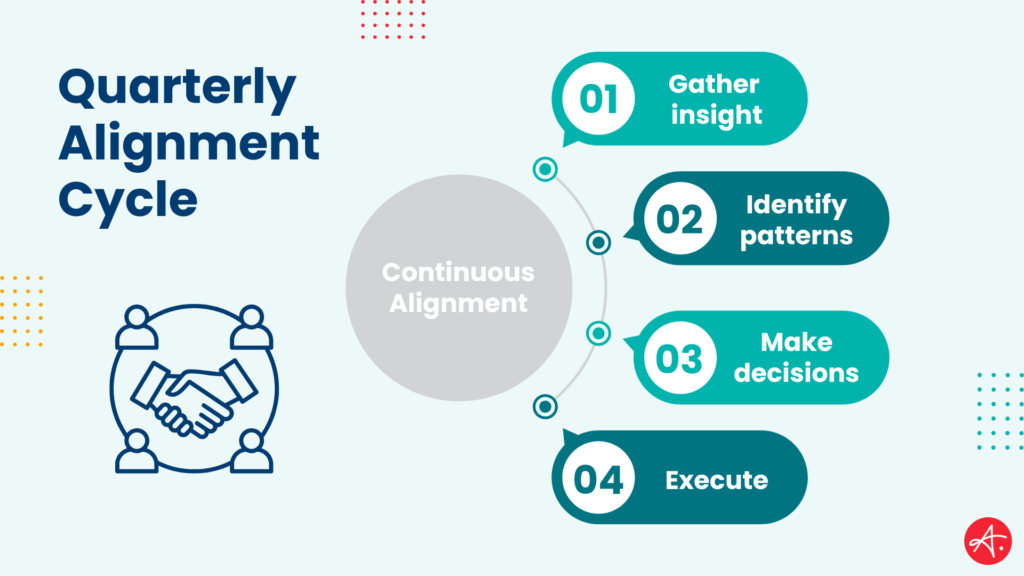
The biggest difference in how we run quarterly workshops as a part of our Authentic Growth® Methodology starts weeks before the meeting. Instead of relying on live brainstorming alone, we begin with a structured, pre-work survey sent to the leadership team and key stakeholders. Everyone answers the same core questions:
- What’s working right now?
- What’s not working and why?
- What must be done in the next 90 days?
This does two critical things. First, it gives every leader space to think clearly without the pressure of the room. Thoughtful answers beat reactive comments every time! Second, it surfaces patterns. When you compile responses across functions, the themes are impossible to ignore:
- Capacity and bandwidth constraints
- Process gaps between marketing, sales, operations, and customer service
- Systems and visibility issues
- Messaging and execution misalignment
Before we walk into the workshop, we’re no longer guessing where the friction is. We’re looking straight at it.
Once responses are in, we analyze them for patterns, not just what people say, but where the concerns are overlapping. If there are three answers that mention “design bandwidth” and two others reference “engineering delays,” that’s the same constraint named differently. By the time we present the synthesis in the workshop deck, the team can immediately see which issues are enterprise-wide versus isolated to one function.
From there, we synthesize the input into a clear agenda and working deck, giving us a tool designed to guide decision-making for the upcoming quarter. This ensures the meeting runs smoothly, stays focused, and respects the team’s time. The goal isn’t to debate whether problems exist. It’s to decide what to do about the ones that matter most.
Waiting for Alignment to Emerge in the Room
Many quarterly meetings struggle because they ask the room to do too much, too late. In all-day sessions, especially those modeled strictly around live input, teams often:
- Spend hours diagnosing issues they already feel
- Debate symptoms instead of root causes
- Let louder voices shape priorities
- Leave with too many Rocks/Goals and not enough clarity
While Entrepreneurial Operating System® (EOS®) meetings are powerful in the right context, I’ve found that relying solely on in-the-room discovery can slow momentum, especially for complex, fast-growing organizations. When answers are created during the meeting, data can be incomplete, context is uneven and everyone’s energy gets consumed on alignment instead of action.
The result? Leaders leave exhausted, not energized. And execution suffers. That’s why the heavy thinking up front can help the meeting itself focus on decisions, tradeoffs, and ownership.
Turning Insight into Aligned Execution
Once the patterns are clear, the workshop shifts from discussion to discipline. This is where quarterly and annual planning sessions begin to look less like meetings and more like alignment engines.
1. Expand the Conversation Beyond Marketing
With smaller and mid-sized clients, we don’t limit these workshops to marketing alone. We bring the entire leadership team into the room. Why? Because most constraints that slow growth aren’t just marketing problems. They’re enterprise problems. Capacity issues, prioritization conflicts, budget tension, systems limitations; those don’t live neatly in one function. When leadership teams solve them together, alignment accelerates.
2. Identify the Real Constraint: People, Budget, or Systems
In both quarterly and annual sessions, I use a simple but powerful lens to focus the discussion on constraints that may be holding a client back. Almost every growth issue fits into one of these three categories:
- People: bandwidth gaps, skill mismatches, or critical single points of failure
- Budget: misalignment between growth ambition and financial reality
- Systems: tools, processes, or data that can’t keep pace with execution
This lens helps teams stop treating symptoms and start addressing root causes. It’s also easy to revisit. Many leadership teams adopt this framing for weekly or monthly conversations because it keeps discussions grounded in reality and prevents overcommitting to plans the organization isn’t yet equipped to support.
3. Surface Risks Before They Become Fires
Another critical section of these workshops focuses on forward-looking risk.
We ask leaders to step out of day-to-day execution and look ahead:
- What risks are already forming as we head into the next year?
- Where could success actually strain the organization?
- What assumptions might break if growth accelerates or stalls?
This is about being prepared. In one recent annual planning session, a leadership team realized their biggest risk heading into the next year wasn’t demand, it was engineering capacity. Sales momentum was strong, opportunities were real, but the systems and bandwidth required to deliver consistently were starting to lag. Naming that constraint early shifted the entire conversation to focus on stabilizing the foundation that had to support them. Identifying risks early gives teams options. Ignoring them guarantees urgency later.
4. Look Beyond the Next 90 Days Without Losing Focus
While quarterly execution is essential, we also create space to discuss:
- Top priorities for the next 12–18 months
- Investments that need longer lead time
- Strategic bets that don’t fit neatly into a single quarter
This prevents teams from optimizing only for what’s immediately in front of them and missing what’s quietly approaching.
5. Add One Thought-Provoking Question That Changes the Conversation
Every quarter, I like to introduce at least one thought-provoking question designed to surface external forces teams might be underestimating. Often these questions touch elements of a broader SWOT analysis:
- Market shifts or customer behavior changes
- Competitive moves we may be ignoring
- External forces like regulation, labor markets, or technology
These questions aren’t meant to produce instant answers. They’re meant to stretch perspective and ensure the team isn’t solving yesterday’s problems with tomorrow’s plan.
How This Works With (and Enhances) EOS®
Many of our clients run on EOS® and this workshop approach is designed to strengthen, not replace, that operating system. The pre-work survey sharpens Level 10 meetings by surfacing the real issues before you’re in the room. Instead of spending the first hour of your quarterly discovering what’s not working, you walk in already knowing where the organization is strained.
The constraint lens (people, budget, or systems) helps leadership teams set better Rocks and ones that actually address root causes instead of symptoms. And by connecting quarterly priorities back to the 3-Year Picture, you ensure short-term execution doesn’t drift from long-term vision.
The goal is the same outcome EOS® is designed to deliver: clarity, focus, and traction. We’re just front-loading the thinking so the meeting itself becomes a decision-making session instead of a discovery session.
Why This Approach Works
Quarterly alignment fails when teams confuse conversation with clarity. By gathering insight upfront, structuring the discussion intentionally, and forcing prioritization, these workshops create something rare:
- Shared understanding
- Honest tradeoffs
- Clear ownership
This approach supports Authentic Growth® by helping leadership teams move beyond random acts of marketing and operations toward focused, disciplined execution. When teams leave the room knowing exactly what matters and what doesn’t the quarter has a chance to actually deliver.
Final Thoughts
The most effective quarterly workshops don’t try to do everything. They do the right things, at the right depth, with the right people in the room. When teams take the time to reflect before they meet, address real constraints head-on, and look beyond the next 90 days without losing focus, alignment stops being aspirational. It becomes operational.
If any part of this feels familiar, or if your quarterly meetings feel busy but not decisive, it might be time to rethink how you’re creating alignment. Want to talk about changing that? Reach out to us today to start the conversation.
Authentic® and our LIFT Integrator Community™ are not affiliated with EOS Worldwide. We run our business on EOS®, and are big fans of building community with like-minded leaders.