Transforming Financial Services: Innovation, Trust, and Market Growth in the Digital Age
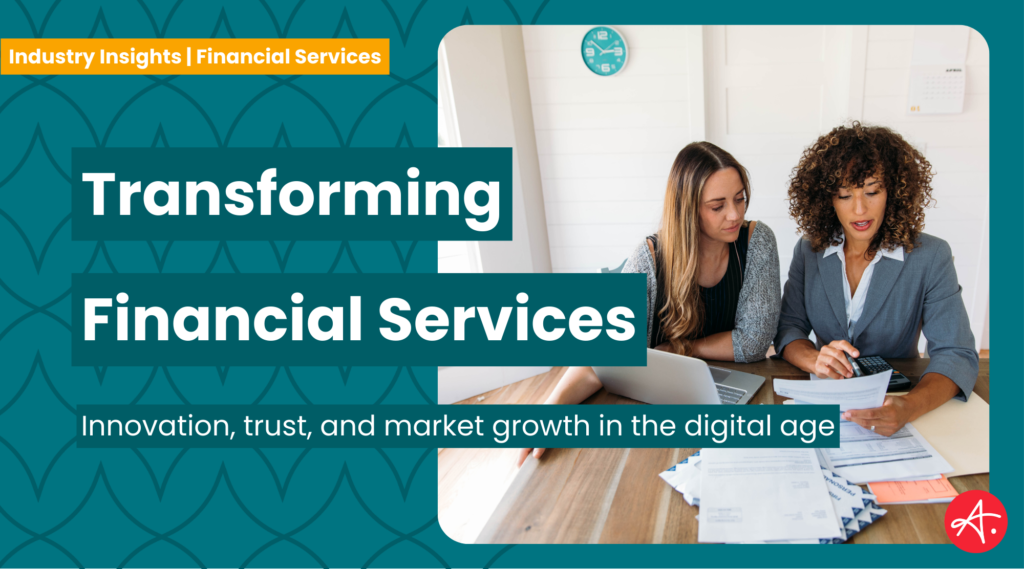
Financial services leaders are navigating a familiar tension: the pressure to innovate faster than ever, while operating in an environment where trust, compliance, and credibility are non-negotiable.
Digital tools, data, and AI promise more personalized experiences and more efficient growth. Yet, many organizations invest heavily in technology without seeing meaningful gains in customer loyalty or market momentum. Innovation becomes fragmented, customer experience improvements stall, and marketing efforts risk becoming disconnected from outcomes leaders actually care about.
To explore how financial institutions can balance innovation, trust, and growth in a digital-first world, we gathered perspectives from three of our own experienced marketing leaders – Jessica Moyer, Sherry Rothenberg, and Kellie Glueck. Their insights reveal a common theme: sustainable growth comes not from chasing the next trend, but from intentionally designing experiences that make customers feel understood, supported, and confident at every stage of their journey.
How can financial services companies use technology-driven innovation to create customer-centric products that fuel market expansion?
Jessica: Financial services has a real opportunity to lean into technology to improve the customer experience, particularly when it comes to gathering and synthesizing customer insights.
By analyzing interactions across digital and personal channels, organizations can better understand what matters most to customers and personalize experiences at a granular level, from channel preference to messaging and frequency. When experience leads, products and market opportunities tend to follow.
There are still many products and services that sit at the intersection of underwriting and sales and we should be thinking more about how to make those painful experiences better rather than attracting more customers with special rates.
Sherry: To be truly customer-centric, financial institutions need to use the data they already have to understand what people need before they even ask. Rather than using data just as a reporting tool, it should be used to uncover real, unmet needs.
By identifying patterns in how people spend, save, and interact, organizations can design solutions based on real behavior, not assumptions. That progress depends on strong collaboration across marketing, product, and compliance to create simple, human experiences that build trust.
Kellie: Data and AI give financial companies the ability to personalize products and predict customer needs more effectively than ever before. Transaction history, spending patterns, and even broader behavioral signals can help organizations see the whole customer and anticipate what support they may need next.
For example, when a customer’s spending is higher than normal and their credit is strong, financial companies could offer budgeting tools to help them control spending, and offer a credit line increase or loan to bundle debt at a lower rate, before their customer even asks them for help. In this situation, the company acts more like a trusted advisor and can better build loyalty.
What strategies are most effective for building customer trust and loyalty in an increasingly digital financial landscape?
Sherry: Trust in financial services isn’t just about strong security or competitive rates. It’s built through relevance, transparency, reliability, and empathy–especially in the moments that matter.
The strongest institutions combine smart automation with real human support. That could mean sending timely messages based on someone’s financial activity, or offering meaningful guidance when a customer is under stress. In a world of digital fatigue, trust grows through simple, helpful communication that makes people feel seen rather than sold to. Brands that balance automation with real care will win.
Kellie: In addition to proactive solutions, financial services companies need to blend human interactions with digital tools and AI-based support. Finances are personal (and often stressful) and not every customer is comfortable engaging solely through digital channels.
By giving people options, whether that’s an AI-powered experience or a human conversation, financial institutions can build trust and loyalty while taking advantage of digital efficiencies.
Jessica: While it’s important to offer a digital experience that is on par with the competition and customer expectations, don’t overlook the frustrations that suboptimal digital experiences can create for customers. I think it’s important to audit the customer experience/journey frequently to identify ways that you might be creating friction and drop-off through digital efficiency.
We’re also seeing signs of digital overload. In-person interactions can be a way to differentiate your brand. To that end, webinars, video, and online events are still important tools for engaging customers and standing out in the digital noise. At a minimum, we should be considering how we might intersperse some personal outreach across journeys to create a surprise and delight experience.
How can financial institutions balance regulatory compliance with the agility needed to launch innovative marketing campaigns and attract new audiences?
Kellie: One of the most effective ways to balance compliance and innovation is to build regulatory considerations into the process from the start. Too often, marketers anticipate resistance from legal or compliance teams and delay engagement until the final stages, which usually leads to rework and frustration.
Also, I encourage marketers to brainstorm with legal as part of the campaign kick-off process, asking legal how they would solve if they say no to an idea. By gaining alignment early on, financial institutions will have the most innovative campaigns.
Jessica: Regulatory compliance exists to protect customers, and when organizations lead with integrity and a customer-first mindset, the gap between innovation and compliance narrows significantly.
That said, sometimes it does come down to different perspectives and personalities. I agree with Kellie that involving legal or compliance early in planning is ideal. Developing good relationships is also helpful for separating requirements from personalities.
I would encourage today’s financial marketers to see these reviews as an opportunity to get creative and think even more outside the box. Limitations (or perceived limitations) often drive innovation. There are so many ways to communicate a quality product or service that go beyond the obvious special offers or promised returns.
Sherry: Balancing compliance with innovation starts by designing processes that include legal and compliance from the start. The goal isn’t to avoid review or just tack it at the end; it’s to build smart repeatable workflows and cross-functional relationships that lead to better understanding and faster approvals.
Pre-approved messages, defined constraints, and reusable templates, combined with strong partnerships with compliance, create the structure marketers need to move quickly while still meeting regulatory requirements. With the right systems and relationships in place, teams can move nimbly and confidently without compromising trust or compliance.
Interested in how an experienced CMO could help your financial services organization achieve strategic growth in the digital age? Reach out to us today.