Tycoons of Small Business Podcast Featuring Jennifer Zick
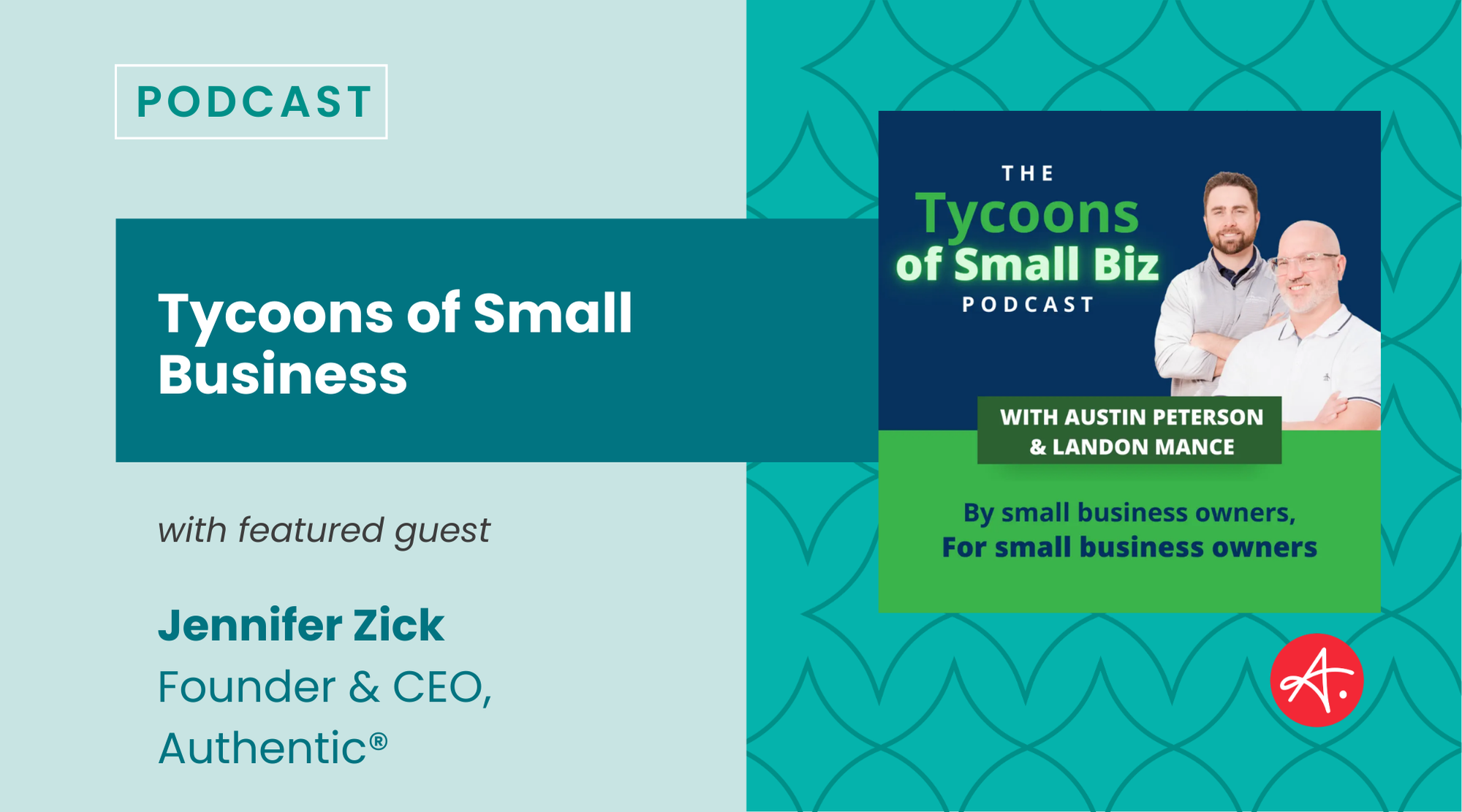
In this episode of Tycoons of Small Biz, host Austin Peterson and co-host Gary Braun (Pivotal Advisors) sit down with Jennifer Zick, founder and CEO of Authentic, for a wide-ranging conversation about what marketing actually is — and isn’t — for growing small businesses.
Jennifer breaks down the critical differences between brand, marketing, and sales; makes the case for why they need separate seats at the leadership table; and shares the three organizational health metrics every business should be tracking. She also explains how fractional CMO leadership works in practice, when a business is truly ready for it, and how Authentic Brand’s model of W2 CMOs, proven methodology, and a curated Ally Network sets a new standard in the space.
Watch the Conversation
Listen to the Podcast
Key Takeaways
- Brand is not your logo — it’s every promise you make to the world and every experience you create delivering on it. From invoices to employee attire to how phones are answered, every touchpoint either builds or erodes brand trust.
- Marketing and sales are a team sport, not a baton handoff. In modern B2B, marketing content reinforces sales conversations throughout the entire buyer journey — straight-line attribution is a myth, and credit battles are a waste of energy.
- Every growing business should track three organizational health metrics: Customer Lifetime Value (CLV), Customer Acquisition Cost (CAC), and Time to Convert. These belong to the whole revenue team, not just marketing.
- Narrowing your focus is counterintuitive but essential for growth. A strategic go-to-market plan acts like a pitcher aiming at a narrow strike zone — putting all resources in alignment to attract the best, healthiest clients.
- Businesses are ready for a fractional CMO around $5M in revenue — not $30-50M, when the damage from random acts of marketing is already expensive. Getting that wisdom sooner is the whole point.
- A strong brand directly increases business valuation. Predictable, consistent marketing tied to a well-articulated brand promise isn’t just a growth driver — it’s a value driver for owners planning an eventual exit.
Podcast Transcription
Introductions
Austin Peterson: Good afternoon, tycoons, and welcome to today’s episode of Tycoons of Small Biz. I’m your host Austin Peterson, coming to you from Gilbert, Arizona — a balmy 82 degrees. Today the first time that Gary Braun is co-hosting with me. Gary has actually been a guest on the podcast in the past. Gary, say hello and tell us what the temperature is in Minnesota today.
Gary Braun: It is certainly not in the 80s, but we are warming up — a nice balmy 45. I’m Gary Braun with Pivotal Advisors. We work with lots of small businesses in the sales arena, and I’m just happy to be back.
Austin Peterson: That brings us to our guest of honor: Jennifer Zick, founder and CEO of Authentic Brand — a community of fractional CMOs who help growing businesses overcome random acts of marketing, which she has trademarked. They help companies overcome random acts of marketing and confidently take the next right step to build revenue. Jennifer, welcome to the show.
Jennifer Zick: Thank you so much, Austin, and Gary for introducing me to Austin and Landon. I’m excited to be here and take a deep dive today.
Jennifer’s Background and the Birth of Authentic Brand
Austin Peterson: We always try to have our guests tell a little bit about themselves personally first. Tell us what you’d like us to know about you.
Jennifer Zick: I grew up in the lakes area of Minnesota — a small town called Perham, about 2,000 people. I was the first in my family to graduate from college. My parents were hardworking, blue-collar small-town people. I went off to college with a lot of determination but no clue what I was going to do with a degree. I changed majors several times — started as a studio arts major with a vocal music minor, then came out the other side as a communications and journalism major. After doing an unpaid internship storm chasing for a TV station, I decided that wasn’t worth the risk for the reward.
My husband and I celebrate 25 years this summer and we have three children. Our daughter Evelyn is a freshman at the University of Wisconsin Eau Claire. We live at home in Chaska, Minnesota with our two sons, ages 16 and 12, who both play hockey. The Zick family lives in two seasons — hockey season, where we’re in the ice rink half the year, and then as much time as possible at our lake home in Hackensack, Minnesota.
Austin Peterson: I’m also the first person in my family to graduate from college. My dad was a stucco contractor most of his career, and both parents had GEDs. So it was a far cry from my master’s degree.
Gary Braun: Pretty common story — neither of my folks went to college either. And by the way, go Blue Gold — I was a University of Wisconsin Eau Claire person too.
What Is Authentic Brand — and Why Fractional?
Austin Peterson: Tell us what really inspired you to start Authentic Brand in the first place.
Jennifer Zick: Authentic Brand just celebrated five years in business last week, and it’s such a wonderful milestone to stop and reflect. Really, Authentic Brand was born in my heart many years before I started the business. My career had been in sales, business development, and marketing — and eventually executive leadership — mostly in professional services and B2B technology. I had a great trajectory, but I also got to the point where I was balancing marriage, motherhood, and career, and really burning out.
I was working for a Bay Area consulting company, rebuilding their marketing team, and I loved the work and the people but I missed my family. I was traveling a ton and thought I could gut it out for another year and a half and then finally start this little company that was on my heart. And really, the PE firm saved me from that — new investors came in, several executive roles were cut including my own. The sudden loss of a job for the first time in my life gave me the opportunity to take a leap of faith.
I gave myself two weeks to not make a decision. I went up to my cabin and started doodling — asking myself: if I were to start a business, what would it be? I came away with a two-pronged vision that still serves Authentic Brand today. I wanted to create a new pathway for small businesses to have access to marketing wisdom sooner — to help them overcome random acts of marketing. And I wanted to help other marketers like myself who were feeling burnout find a different way to love their lives and their work. Those became the two north stars for Authentic Brand’s creation.
Gary Braun: The notion of fractional anything has been growing with small businesses. We do it on the sales side, you’re doing it on the marketing side. How do you see that growing when it comes to marketing?
Jennifer Zick: Fractional CFOs were actually how I found the word ‘fractional.’ I had never come across it previously. Once I started meeting fractional CFOs and fractional HR providers, I realized that was a category — and I hadn’t run into anybody doing fractional sales or marketing yet. Five years ago, nobody was searching for ‘fractional CMO.’ It wasn’t an established category. So I considered it part of my contribution to the world to create that education and marketplace.
Now, five years later, people are searching for that term and we’re in a position to continue to grow as a market leader in that space. Many small businesses are understanding the real value of focusing their full-time permanent positions on the core of what their business does, and staying flexible around that core with proven experts they can actually afford to bring in on a fractional basis.
Brand vs. Marketing vs. Sales
Austin Peterson: There are three terms that get used interchangeably without people realizing the difference: branding, marketing, and sales. I’d love to hear your definitions of each.
Jennifer Zick: Brand is bigger than a logo, fonts, and color palettes — but too many businesses treat it like that’s what it is. Your logo is a part of your brand, but brand is the promise you make to the world and how the world experiences you delivering that promise. Brand is every touch point with every stakeholder at every interaction. Brand is how your invoices go out the door. Brand is how somebody’s greeted if they show up at your physical office. Brand is what your employees wear. If your promise is out of sync with the delivery, you’ve broken trust and that erodes your brand. If your promise is in sync with the delivery, you’re building brand.
Marketing’s job, in part, is to bring the whole organization along on what the brand is going to be and help provide infrastructure for every player on the team to support that brand experience with every stakeholder — prospects, customers, employees, prospective employees, investors, board members, everyone.
Too often marketing gets pigeonholed as demand gen. Founder-led, sales-driven businesses say ‘we’ve juiced the turn up, we don’t have enough leads, let’s hire marketing — they’ll fix it.’ Then they activate a 90-day digital experiment and hope it turns on qualified deals. Marketing is supposed to operate both like a checkbook and a long-term investment account. Yes, it helps enable engagement and conversion along the buyer journey. But it’s also maintaining your long-term investment strategy — building brand equity, building trust, knowing what you stand for and delivering on that promise consistently.
Which is why your head of sales should not lead marketing. You need a marketing leader to partner with your head of sales — so sales can operate in the right now, keeping that pipeline moving, while marketing supports the entire lifecycle of the brand journey.
Gary Braun: Usually when I see a VP of Sales and Marketing or a Director of Sales and Marketing, they either have a capital S or a capital M — it’s a very different skill set. I’d also say over the last five to ten years, with buyers going 60-70% through their sales cycle before ever talking to a salesperson, sales and marketing have become even more intertwined.
Jennifer Zick: Everything changes all the time in the world of marketing, and yet nothing ever changes. The part that never changes: no matter how much the buyer journey and technology shift, sales and marketing are really about connecting human to human. Nobody buys from a brand they don’t trust or a person they don’t trust. But how we do the dance along the way has changed a lot.
In a B2B world, it’s very hard to do a straight-line attribution from ‘they came to this marketing event, therefore marketing gets credit for the revenue.’ That’s just not how it works. It’s a team sport now more than ever. It used to be a handoff of the baton — marketing sponsored a trade show and gave a list of names to sales. That’s not how it works anymore. Marketing has conversation starters, sales enters at some point, but there’s still team-sporting on all of it. That marketing content — the podcasts, the blogs — is supporting and reinforcing the sales conversations along the way, adding layers of trust. We are all aiming for the same goals. If all ships are rising and the company is meeting its goals, we don’t have to fight over who gets credit.
The Three Marketing Metrics Every Business Should Track
Gary Braun: You talk about data, you talk about metrics, you talk about unification. What are the key things that sales and marketing should be looking at together?
Jennifer Zick: I call them the Big Three — and they’re not just marketing metrics, they’re organizational health metrics. This can’t be done on an island by the marketing leader. It has to be done in partnership with the revenue team — finance, sales, marketing, and usually the founding team.
The first is Customer Lifetime Value. You’d be amazed how many small businesses are obsessed with getting at-bats and winning new deals but have no obsession at all about retaining the clients they already have. They’re letting business walk out the back door while only watching the front door. Retain what you have and make it work better — that’s opportunity number one for healthy growth.
The second is Customer Acquisition Cost. In B2B, the easiest way to measure CAC is to agree as a leadership team on the formula: what is the total cost of running sales and marketing — staff, activation, everything — and how much new revenue did we see as a result? Do the simple math. Know that number, then focus on optimizing it. Too many businesses think the only path to more growth is hiring the next sales rep. There’s probably a combination of brand building, marketing investments, and the right sales team balance that would get you to a more optimized cost of acquisition.
The third is Time to Convert. In B2B professional services, a buying cycle can be six to twelve months with five to ten stakeholders involved. If you can understand your average time to convert for your healthiest clients, you can start to optimize that process — and bring marketing and sales together in that journey to identify where things are getting stuck and how to remove friction.
Focus as an organization on CLV, CAC, and Time to Convert and you’re watching some of the most important, most measurable dynamics of your business that your entire revenue team should care about.
Gary Braun: When you go into a small business that hasn’t made that leap yet — what are they looking at, and how do you get them thinking about these things?
Jennifer Zick: Sometimes the change can be driven by data, and sometimes it has to be driven by discipline. In most small businesses we walk into, we’re looking for data — but some businesses have never put systems or process in place to even capture data. That’s actually pretty common. For those companies, it’ll take at least a whole year to capture baseline data before you can start seeing patterns. After a couple of years past patterns, you can start to be predictive.
Before you get to data, though, you can get to discipline. The first change most small businesses have to make is to start saying no. Not all revenue is healthy revenue, and not all of it gets you to next-level results.
Here’s my baseball analogy: think in terms of a baseball team. Your operations — your product or service delivery — is your outfield: wide range of capabilities. Add sales, and you’ve got an infield — more focus, more defined industries and solutions, but still some maneuverability. Get a marketing leader and a real strategic go-to-market plan, and they’re your pitcher, aiming for a very narrow strike zone. Everything else becomes opportunistic. That helps put all of your marketing dollars and resources aiming in the same direction, attracting your best and most ideal clients. It sounds counterintuitive to narrow your focus, but that’s the path to healthy growth.
When Is a Business Ready for a CMO?
Austin Peterson: When is a business really ready to bring on a CMO?
Jennifer Zick: If a business was looking to bring in a full-time executive CMO, they’d probably need to wait until they’re $30 to $50 million in revenue to afford that role. But by then they will have created some very expensive random acts of marketing — which is why I built Authentic Brand, to get them that wisdom sooner.
We work with businesses between $5 million and $100 million in revenue. By the time a company has experienced enough marketing pain to recognize they truly need a strategic leader — not just more people doing stuff — usually $5 million and above, they have the business foundation and leadership team to make that role a success. They have a proven offering to bring to market, and they’ve probably been spending six to seven figures already in various marketing experiments.
Common denominators for our clients: $5M to $100M in revenue, at least a six-figure activation budget, and the appetite to commit that this role will be on your leadership team for at least the next two years — building foundation, maturing the organization, getting data organized, and bringing the right players in to build a mature, modern marketing organization.
Gary Braun: What are the triggers that tell a business leader there’s a better way?
Jennifer Zick: All of our clients are growth-focused — they want to make bigger gains and they’re seeing those gains start to taper off. Or they’re finally building a next-level sales team and they know that needs more what I call air cover. Or they’re looking at a key event: a potential exit in three to five years, a strategic acquisition on the horizon, expansion into two more markets or product lines.
Major moves, major growth initiatives, unsatisfied with the status quo — those are the businesses that need to start making space for a marketing leader to help steer the ship. Not a marketing leader who reports to someone on your leadership team and just organizes agency resources. A marketing leader on your leadership team, as a business advisor first, helping make sure your brand promise is well articulated and everybody is well aligned around it.
Gary Braun: All owners at some point are going to exit the business — sell it, ESOP it, pass it down. One of the big things that discounts the value is not having a good sales and marketing engine. If it’s unpredictable or inconsistent, that goes away.
Jennifer Zick: That’s right. Not only in the dollars and cents of the actual valuation, but in the culture, employee review scores, the reputation you have in the market, the longevity of your client engagements — all of that is supported by a strong brand. Even if you’re not ready to fill that CMO seat yet, it’s essential for the leadership team to understand brand building and the value of a focused story told consistently, lived out authentically, and delivered to create great trust. That is the accelerant in business growth and value.
What a Fractional CMO Actually Does — and Doesn’t Do
Austin Peterson: A CMO’s role is typically strategy and leadership. But there are also the tactical sides of marketing — website design, content, SEO, web development. Do you do that as well?
Jennifer Zick: The answer is no — we don’t sell any services besides leadership of marketing teams, programs, strategies, and all of the players who help execute. One of the variants of fractional CMO in the market today is traditional agencies who are now offering fractional CMO services by relabeling their strategic account manager. That is not the same as the kind of fractional CMO leadership we provide as a member of your team, representing your best interests and not selling other services.
What we do is help clients move their activation forward through our curated Ally Network of providers — the marketing ninjas across the most important disciplines for modern marketing organizations. We have over 30 providers who are either freelancers or small agencies specializing in areas like SEO, PPC, e-commerce, web development, creative, and copywriting. Our clients are never obligated to use them, but it’s available to fast-track access to vetted, values-first, nimble providers with true specialization. Agencies that do it all don’t do much in terms of value — agencies today have to be laser-focused in one to three disciplines and partner transparently with other providers.
Austin Peterson: What does the marketing department typically look like internally for the businesses you take on?
Jennifer Zick: It’s about half and half, and interestingly it’s not necessarily based on revenue. Half of our clients have zero full-time marketing staff when we arrive. They’ve executed marketing through borrowed time from internal staff and project-managing a few agency and freelance resources. Very random.
The other half have made some great hires — dedicated, loyal, capable marketers on staff who’ve been trying to organize their work while reporting to someone in sales or another executive who doesn’t have a marketing background. And they end up responding to a big shiny object list. Without a strategic leader, marketers become the junk drawer of the organization: ‘Hey, we have a client visit — marketing, can you organize a lunch?’ ‘Hey, we’re doing an all-hands — marketing, put out a campaign.’ I see a lot of great businesses hire great marketers and then lose those great marketers for lack of clarity, direction, and empowerment.
Gary Braun: When you kick off with a new client, are there two or three things you always address first?
Jennifer Zick: Every client has different things in flight or on fire when we arrive — commitments that need to be seen through. So from day one we take a dual role: we’re at the helm leading the team, contributing as an executive, and helping see commitments through. But we’re also getting under the hood through our methodology — a fast-track discovery and assessment in the first six weeks to get us down to an action plan right away. What needs to happen in the first 90 days? Where are the gaps, where are the opportunities, what resources can we devote? Then we roll that into a longer-term marketing roadmap refreshed quarterly.
The most commonly missing things I see: clarity of marketing roles and accountability, and a cadence for communication. It’s very ad hoc. One of the first things we put in place is cadence — meetings from the top all the way through to every vendor supporting marketing. None of our CMOs came out of an ivory tower in a giant corporation with billions in ad spend. We’re very close to ground-level, entrepreneurial marketing leaders who love to roll up our sleeves, link arms with the team, get people in the right positions to thrive, and be good stewards of our clients’ resources.
Closing Thoughts
Austin Peterson: Jennifer, I think the story you have is very unique. And the biggest struggle any business has is how to communicate its uniqueness to the marketplace. I think you’ve done that better than probably 99.9% of business owners I’ve ever met.
Jennifer Zick: That could be the highest praise I’ve ever received as a professional. Thank you. I really want my little five-year-old business to be the best case study for how we can help build other authentic brands. I’m overjoyed to do this work and to keep firing myself from jobs and creating opportunities for other people. I’m really grateful the universe gave me a challenge five years ago and helped me take the leap.
Austin Peterson: How can listeners connect with you and Authentic Brand?
Jennifer Zick: I’m easy to find on LinkedIn — just search Jennifer Zick. To learn more about Authentic Brand, visit authenticbrand.com — all one word, no S at the end. We create a lot of great content written with the entire executive team of entrepreneurial businesses in mind: webinars, learnings, ways to engage. We’d love to invite you to be in our circle.
Gary Braun: I’ve known Jen since she started the business. She’s built quite a culture there. People love working there, the clients love her, and they do an awesome job. It was a pleasure to have you on the show today.
Jennifer Zick: Thank you both for the invitation. It’s been really fun. I appreciate it.