Dynasty Leadership Podcast Featuring Jennifer Zick
How to Overcome Random Acts of Marketing
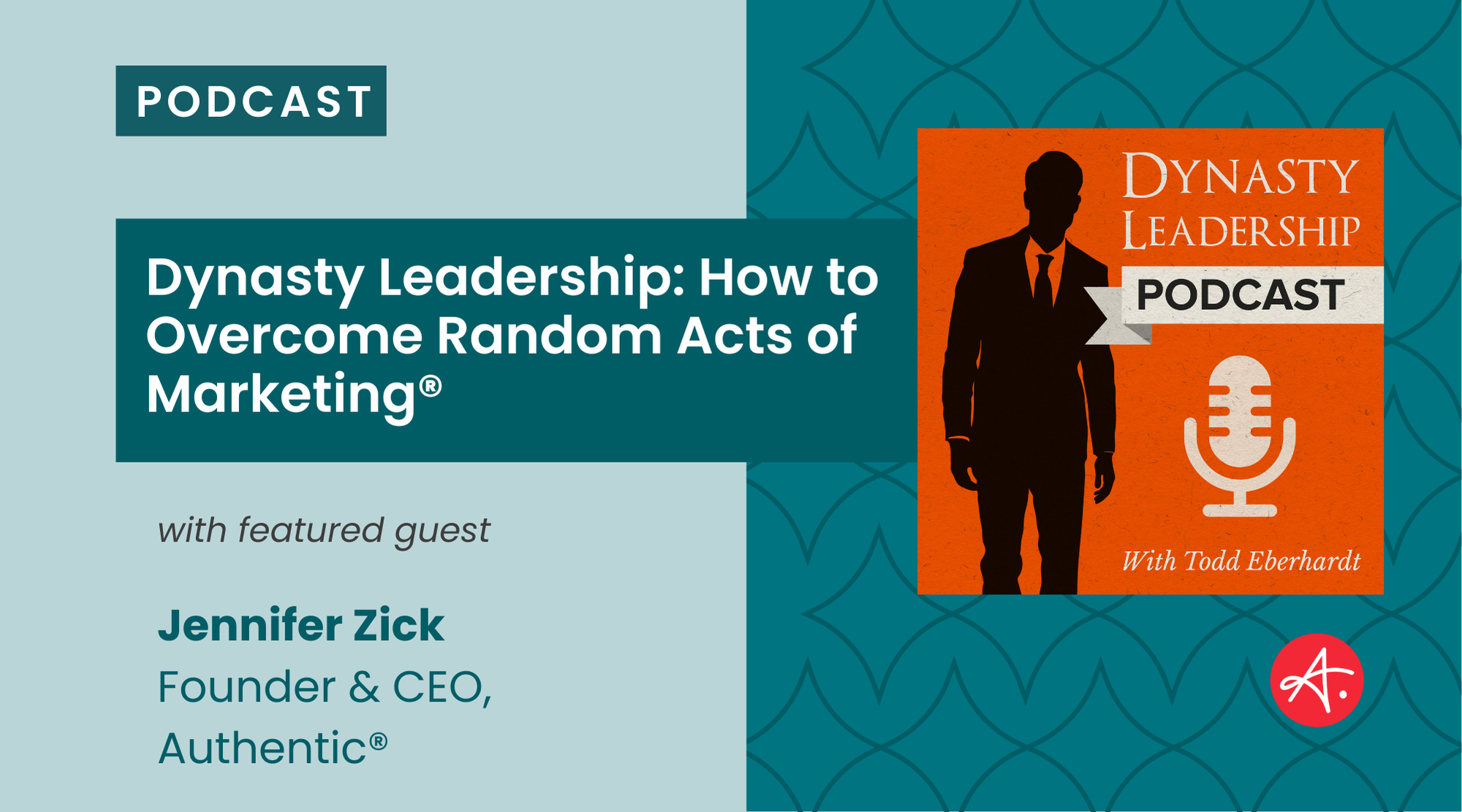
Our founder and CEO, Jennifer Zick, was recently the featured guest on the Dynasty Leadership Podcast, with host Todd Eberhardt.
In this episode, Jennifer shares how a fractional CMO can help revitalize your business when you’re in the middle of the growth stages. She offers a seven-part framework to help break out of any marketing funk you might have.
Listen to the Podcast
Key Takeaways
- Sustainable marketing growth requires a structured, repeatable framework—starting with purpose and business goals—rather than reactive “random acts of marketing.”
- Many growing companies face a marketing leadership gap, and a fractional CMO provides executive-level strategy, alignment, and accountability without the need for a full-time hire.
- A strong marketing foundation—clear ideal customer definition, brand messaging, technology infrastructure, and measurable metrics—must be built before scaling tactics and campaigns.
- Marketing and sales must be tightly aligned around a clear definition of qualified leads and the buyer journey to avoid wasted effort and frustration on both sides.
- Impatience and misaligned hiring (such as searching for a “unicorn” marketer) are common mistakes that undermine long-term marketing effectiveness and ROI.
Full Transcription
Introduction
Todd Eberhardt: Hello, everyone, and welcome to another episode of Dynasty Leadership Podcast. I’m your host, Todd Eberhardt. You know, for all of our businesses, we work so hard to get noticed out there. We want to be good markers, we desperately want to be good marketers. But, like, if we’re honest with ourselves, we’re not all cut from the same cloth when it comes to it.
You know, the theme that we’re going to have for today is how to overcome random acts of marketing. So think about this, right? Think about the pain that comes with that marketing campaign that you developed, you know, in your garage or with your wife or your kids or whatever, and it lands with a thud, okay? Think about the money that you spend that goes out the door with nothing to show for it at the end of the day, okay?
Think about what happens because you know your story so well and yet no one else seems to be able to understand it when you tell it. Those are the things that get frustrating. Look, I say that because I know from personal experience, you know, we’re not all great at it. Fortunately, I have somebody today with us that is really good at it, and that is Jennifer Zick. She is the CEO and founder of Authentic. They are a fractional CMO firm for growing businesses. Now, she’s got a more eloquent description of that, and that is why I’ve invited her to speak live with us today. Jennifer, welcome to the show.
Jennifer Zick: Todd, I’m so delighted to be here. Thank you so much for having me.
Todd Eberhardt: Yes, absolutely. Okay, you tell us. I gave the simplistic, they gave the grade school version. Tell us really what’s Authentic all about?
Jennifer Zick: You did it beautifully. I’m hiring you for my next marketer. Todd, no Authentic. We are a community of fractional CMOs or chief marketing officers that help growing businesses to, as you said, overcome random acts of marketing and confidently take the next right step in growth. So what that means is we generally are working with established growth businesses. That’s usually between 5 and 100 million in revenue.
So they’ve been founder led, sales driven, doing some marketing things, but they recognize that getting to next level growth means being much more strategic in their marketing and they probably have a leadership gap and that’s where we step in.
Fractional CMO Role and Market Position
Todd Eberhardt: Okay, so let’s just touch on that for a second. When you say leadership gap, what does that really mean?
Jennifer Zick: Yeah. So for most growing businesses, the functional roles filled in the leadership team first are often at the founder or CEO and somebody leading sales, which may or may not be that same founder, somebody handling operations or services delivery, and somebody leading finance. Those are kind of the three big buckets. And when marketing starts to be a more prominent component of the business, it’s often first tucked under one of those buckets, if you will.
Maybe marketing is being led by the founder, led by sales. There might even be some marketing staff members in the business, but there isn’t yet an executive marketing leader on the leadership team. Okay. And so when they, when businesses are really looking to scale, having that right marketing and sales alignment in leadership for strategic integration becomes really important.
Todd Eberhardt: Okay, so you said 5 to 100 million. So they started to stretch themselves beyond what just pure hustle and sales can get them. Right. They’ve gone as far as they can with that. And they probably tried some other things. Like, you know, some of the things I said at the beginning that I probably tried and fumbled around. Let me just ask you, do you find them? Do they find you? How does this work?
Jennifer Zick: Well, usually they find us, but that’s because we’ve been very strategic in our marketing. Ironically, Authentic is a five year old business. But my background for 20 years prior to starting Authentic was in sales leadership and then marketing leadership. And so I stepped into my business with some tools in that toolkit and began working pretty aggressively early in the business to develop pretty rich thought leadership and content and events and opportunities to share our story through different formats and also start building networks of referral relationships through high trust advisor relationships.
So we’ve been really fortunate to surround ourselves with high trust advisors who feel confident in referring their CEO clients to us when marketing starts to be an issue on the board.
Todd Eberhardt: Gotcha. Okay. So now they start to recognize it as if we want to continue to grow, we need to do more than just hustle. Right? And they’ve come to recognize you through a number of different ways, through your own marketing as well as through satisfied clients, those types of things. Can you help our audience understand who’s the person we’re talking about? What’s their situation that they’re in right now to say, okay, what’s going on? That might sound like me.
Jennifer Zick: Yeah. Well, many of our clients are facing transitional moments in their business to grow. They’re either entering new markets, entering new buyer communities. Perhaps they need to move beyond those who know us to those who should know us. And they don’t know the path to get there. They might be making acquisitions to expand their business footprint, or they might be a few years out or in a closer timeframe to being positioned for acquisition.
They’re at big, pivotal moments of growth and value creation and change, and they need to feel confident about where they’re placing their bets to create value. And for us, the three areas that ultimately are impacted by the work we do are value creation in terms of revenue, profitability and business valuation. So that’s the impact we make as a fractional leader and a member of their leadership team.
So for those listening, Todd, who has never heard the phrase Fractional CMO, because I hadn’t when I started my business, it simply means a part time executive. So we work as the head of marketing with full accountability for these entrepreneurial teams and we’re with them through major growth and change, usually for over two years, building strong, high performing marketing teams, programs and outcomes.
Todd Eberhardt: Are you in a sense attempting to work yourself out of a job as they grow?
Jennifer Zick: Then, you know, some fractional leaders make that their number one goal. Get in, provide strategic direction, maybe hire some people and get out. We are of course, trying to provide strategic direction and help the team grow, but we also recognize that growth and value creation takes more than one cycle to create and complete.
And so one of the tools that I’m also happy to share with anyone who might reach out to me after this show is our Authentic Growth® Marketing Maturity Matrix, which shows the stage gates that businesses often move through as they build more maturity in their marketing organization and value in their business. Moving from founding all the way over to flywheel. Right. So we are with them on that journey through all of those components of building maturity. And so that takes time and it goes through multiple evolutions.
So we are not what you might call a flyover. Sprinkle down some strategy consultant, fractional CMO who then passes the baton over and says, best wishes we are roll our sleeves up in the trenches, walk alongside this leadership team to build value.
Todd Eberhardt: Okay. I imagine that becomes one of the separating points as well that we’re going to talk a little bit more about, right?
Jennifer Zick: Yes, I hope so. That’s the plan.
Marketing Foundation and Strategy Development
Todd Eberhardt: I did. What I do want to say is, I really like the phrase that you let off with before getting to beyond those who know us to the ones who should know us. I like that. That’s very cool. And it does speak to the essence of what you do. So I have a question. I do want you to go through the process, but I just want to be really honest. It’s like marketing sometimes feels real squishy, but when you talk about business valuation and things like that, sales growth, those are really recognizable things that you should be able to measure, right? How do you feel about it? I don’t want to be offensive with the squishy part, but you know what I’m talking about, right? Let’s just address that right away. Tell me your thoughts.
Jennifer Zick: You’re not going to hurt my feelings. For almost all of the entrepreneurs that I meet with and founders and CEOs and their CFO counterparts, marketing has become a big frustration because they’re putting dollars in and they don’t have line of sight and clarity to what is manifest. On the other side of that, it is nebulous, it is squishy. It feels creative and ethereal instead of practical and logical and measurable. But it doesn’t need to be that way. Marketing certainly has aspects that are creative, but there are a lot of components that need to be tied together, knit together and communicated, and practically managed toward outcomes. And that’s part of what you’ll hear in the process I’m going to share with you and your listeners today is some steps that we go through with our clients to demystify marketing.
Put it into a practical business plan with measurable outcomes and take them on that journey. Because you don’t get there in three months. I know every CEO wants to know that they can, but it’s not. That’s not realistic. So it’s a process.
Todd Eberhardt: It’s probably part of your early screening, too. I like that. Let’s do this. Help our audience out. If you can hit the highlights, kind of the major key points of that. Let’s have you go through that, and then let’s talk about it a little bit so people can understand it better.
Jennifer Zick: Absolutely. So the part of the process I’m pulling forward for our conversation, Todd, comes from a much richer, deeper methodology that we use in our client engagements. And our methodology is called Authentic Growth. And when you bubble that methodology up and you look at the core components of it and how organizations need to move through that process, there really are about seven key steps. And those steps are not something you do once one through seven. They’re steps that you take repeatedly in the business to continue to assess the market, the opportunity, the outcomes, and agilely adapt your overall marketing roadmap and those steps. You know, I think some of your listeners are pretty familiar with Simon Sinek and the Golden Circle and the start with why concept. Know your purpose. That’s where we begin.
And then we move from purpose to business goals, to business priorities or key initiatives, to building the marketing foundation that leads to a marketing strategy, a resourcing plan to back that strategy up, and then the channels, tactics and, you know, the campaigns and the activation of that plan. So that’s the process and we can dig in and share some stories.
Todd Eberhardt: Yeah. Well, let’s start at the top then. I’m interested in the purpose because you have to start somewhere. So how do you connect with them? Tell me about the purpose. What does that look like?
Jennifer Zick: Well, I love to talk with founders and ask them, you know, why did you start the business in the first place? Right. What is your life changing purpose for existence as a business? From the heart of a founder or from the core of what the business is about and how it impacts lives? Because really, if you can’t answer the question of how you’re changing lives for the better through your business, I don’t know why you’re in business. And neither will your employees or your potential buyers or partners. Right. So you need to know what your.
Todd Eberhardt: Purpose is and then that’s great. But what if somebody’s just so direct as to say, look, we’re here to make money, that’s our job. How do you work with that? Is that something you can work with or is that a walk away signal?
Jennifer Zick: No, it’s legitimate. Everybody comes from a different center. Purpose. Now would I say that’s the most attractive purpose and is going to reap the most rewards for a business owner? Probably not. But if the purpose of the business is simply to make money and they’ve got a practical pathway for it’s just important to be honest about that because your purpose is a magnet, you know, or you know, it has a magnetic pole and a push. Right.
It’s going to attract the stakeholders who agree with that purpose and can come around it, support it, and it’s going to repel those who aren’t attracted by your purpose or don’t agree with it. So if you want partners that align and buyers that feed your purpose and employees that can help you execute it, you need to know where you’re centered and be honest about it.
Todd Eberhardt: I like that. We’ll have a pull and a push. Very good, Very good. Okay, so you talk through purpose. You have an understanding deeply, what is it they’re really about? What are they trying to accomplish, who are they trying to change? Perfect. Let’s talk about business goals. What is it that you’re really after for that? Are you creating them? Do you figure they’ve already got it and they just want to share it? Where are people at in their kind of step in their progress?
Jennifer Zick: Yeah, I can’t tell an owner and their leadership team what their goals ought to be, but it always surprised me and still does surprise me, though it shouldn’t anymore. How many businesses get to a point of substantial growth without ever having really set realistic goals or having a framework to do that? So I talk with a lot of brilliant visionary entrepreneurs who make statements to their teams like, we’re going to 3x in 18 months. That’s the goal.
But they have no pragmatic, practical history of performance that can back that up so that the team can believe that’s possible. And they don’t have a plan moving forward that demonstrates how that’s possible other than let’s make it happen. Right. And that’s a really good way to disincentivize and demotivate a team and cause chaos.
And so, you know, we’re big believers in being realistic with your goals, having goals documented, having, defining that North Star that you’re trying to move your team toward, and clarity of roles for how is everyone in the organization going to help support specific goals? And at Authentic, we have found it really helpful to do that goal setting through an operating system. We happen to use the Entrepreneurial Operating system, or eos. There’s a lot of different tools that help growing businesses make practical goals and align their organization around those goals. So they’re all moving toward a North Star they’ve agreed to and can understand.
Todd Eberhardt: So circling back to your point about the one that let’s just say for argument’s sake, they want to triple the business next 18 months or two years. Do you stress test that a little bit to see if there’s some history to back that up? Is there enough of an engine there to support that? Is this where we kind of call it out a little bit?
Jennifer Zick: Absolutely. We are not afraid to challenge assumptions that business leaders are making because it’s our job to help them create clarity and then put an actionable plan in place that can drive valuable outcomes. But we’re not going to burn our reputation or their team out trying to strive for something that’s completely unrealistic or promise over promise something that can’t be delivered so the way to stress test that.
There’s a couple ways to stress test from our perspective, the objectives and goals that the leaders are defining. First of all, corporately, do they understand what their values are and are they setting goals relative to their values? Do they know as an organization what they want out of the growth of their business? How do they define healthy growth? Is it profitability? Is it revenue? Is it business value creation? What is it they’re aiming for?
Does the owner know and have they identified what their ownership goals are from their business? And then when we look at practical data to support this growth through this organization, we have to look at what’s in the pipeline right now. Sales pipeline, what do they have for current customers and the retention of those customers or repeat purchases from those customers. What can we actually do the math on to say, here’s what we know we do have that will lay the groundwork for next year’s goals and here’s what our pipeline tells us. We can close in what amount of time and here’s what the market is telling us in terms of the velocity of leads. Right.
And we got to look at all of those things and the team and then understand the owner’s appetite for investment to achieve the pace and progress they’re looking for. Because you can say you want a 3x in 18 months all you want, but unless you’ve got the fuel to propel that rocket and you’ve got the appetite for that kind of aggressive growth and you know the market will sustain its wishful thinking.
Todd Eberhardt: Yeah. Could also break that rocket too.
Jennifer Zick: Goodness, you absolutely can break a rocket. You can put a lot of fuel in a rocket and then if it doesn’t have the rest of the pipes to support that speed, it will just implode. Right. Or explode. Yep.
Todd Eberhardt: Yeah, absolutely. Okay. I like that. I like the idea of stress testing. Quick question though. You talk a lot about strong entrepreneurs and things like that. Do you ever deal with companies that are private equity or have outside ownership? Founder, if you could talk about that for just a second.
Jennifer Zick: Absolutely. We’re doing more of that work now. And so then the business goal setting is a balance between shareholder expectations and stakeholder expectations and the agreements that have been made in the value creation within the business. So we’re often brought in as third party advisors and internal champions to help manage expectations across those groups. Manage the expectations, report on progress. You know, the thing that happens with a lot of PE investments or acquisitions is that prior to the deal being done, everybody has done their Due diligence from the financials, they’ve peaked under the hood. But they often really don’t know what they’re walking into in terms of a sales and marketing organization other than what’s in the numbers.
There’s a lot of deeper analysis and assessment that needs to be done to help those leaders feel confident or understand where the risks are in terms of meeting their goals in the timeline that they have in mind.
Marketing Execution and Program Management
Todd Eberhardt: Good thoughts, good thoughts. Okay, let’s keep going. Next would be business priorities, right?
Yeah. So out of goals come priorities and in our world, because we run on eos, of course we have like the goals that we’re setting, which might have to do with revenue growth in a year or number of clients we want to acquire or markets we want to see expand underneath. Those are the business priorities, not just marketing. It’s what initiatives are going to help us reach our business goals from across the organization.
So these are like, how do you build and maintain the pipes that support the growth of the company? So those business priorities might be to reach our growth goals, we’re going to have to recruit more talent to reach our growth goals. We’re going to have to build this new partnership out really well. Or we need to make sure we increase our client retention from 60 to 80%. Right.
Jennifer Zick: So those business priorities become the flags that we mount for the year to say we’re going to move forward as a leadership team, achieve these priorities that support the growth. And out of those priorities, then the departments align on how the organization is prioritizing annual quarterly day to day initiatives. So business prioritization is really important. And when it comes to prioritizing on the sales and marketing side, we see far too many companies put too much expectation on new business acquisition with, well, not too much. I mean, that’s a great goal. New business acquisition is a great goal, but not if you’re ignoring retention, expansion and advocacy with your existing customers. Right.
Todd Eberhardt: Is it sometimes, and I certainly don’t want to put words in your mouth, but I totally get the idea of driving for new business because we all talk about that and it’s exciting, but sometimes maybe it’s not ignoring, could it ever be just overlooking? These are gems. Look, it’s a 10x job to try and get new business versus working better with people that already love you. Right?
Jennifer Zick: Yes.
Todd Eberhardt: So does that become, well, maybe we should back up a little bit and not drive so hard for new business, but let’s look over in aisle B kind of thing.
Jennifer Zick: Yeah. Yeah. Well, there’s the hard work of growing a business. And there’s the easier work of growing a business. And it’s much easier to retain and build existing customers, especially if they’re happy than it is to win new customers. Of course, you need good, healthy flow on both sides of that. But you’re right, Todd. No business leader or team is saying, let’s not care about our current clients and customers, let’s just go after new. Right. Unless they’re making an extreme pivot and they’re offloading some poor fit clients. But it’s not lack of intentionality, it’s lack of structure and process for the nurture and management of those relationships.
Todd Eberhardt: Yeah, well, I would think that’s where you could provide some balanced insights based on history that you’ve had with other clients and things like that, and help them see some things that look, you know, they talk about quitting, digging three feet from gold kind of thing is like, you’re so close, you don’t have to go to all this new stuff. You don’t have to find a different mountain.
Jennifer Zick: Well, I have a great story about that in a recent client engagement where we entered into a fractional CMO role with a well established SaaS technology company that was a CRM solution for a specific marketplace. And they had been the only contender in that space for 15 years. So they had a lot of business, but suddenly a very highly capitalized new contender came in with only about 20% of the functionality from a product perspective, but a lot more sales and marketing funding, brand awareness, and they were winning over clients, they were taking market share and stealing clients. Right. So when we entered the picture, the CEO’s first objective that he articulated was to help us go win more business.
But when we looked under the hood, we recognized that not only were they at risk of losing clients to a very aggressive competitor, but they had a risky imbalance across their client accounts where two key clients made up about, you know, a very significant portion of their revenue and both of those key client accounts were at risk. And when we identified that the first priority of marketing leadership was to come alongside of sales and articulate the retention value proposition within those accounts, secure those accounts, bring everybody else along in terms of retention and relationship, and then start getting clarity of go to market for new business. And that was very successful.
And as we took the right path forward, retention, first don’t lose existing business and then more focus on new business and then brand, you know, the brand clarity and the marketing focus that we led through there by the Time that business was ready to go raise capital to contend against the competitor, they actually had an offer to be acquired that turned out to be really advantageous for them. So yeah, so again, that’s just a story about. Don’t forget to really examine the entire ecosystem of revenue and growth for your business. Because it’s not all just demand gen. And marketing’s role is not only demand gen, it is relationship. Brand experience and customer acquisition and retention and advocacy.
Todd Eberhardt: Good thought. Very good thoughts. Okay, let’s keep going. Marketing Foundation.
Jennifer Zick: Marketing Foundation. This is where it gets real, Todd. Because so many entrepreneurial businesses want to jump right down to the last step in this model, which is activation. We’re all eager to activate. And listen, we never walk into a clean slate environment where nothing’s happening. We’re always walking in where there’s a project going on in marketing or they’ve already made a sponsorship commitment over here and they’ve got a big event over here. We have to be able to move the train down the tracks while also assessing the situation and making improvements. Right.
So Marketing foundation is often a whole core component that’s been missing in these businesses. And when I talk about Marketing Foundation, I’m talking about several components. I’m talking about a clear definition of your ideal buyer and customer and what their journey with your organization should look like.
Brand and message clarity that fits your ideal target audience and that resonates and creates differentiation from your competitors. I’m talking about the technology and the martech stack and the processes and the functions that need to work to enable your marketing program. And of course, the data and metrics and reporting that give you the intel, both the leading and lagging indicators of how your marketing is performing. So without that Marketing foundation thoughtfully crafted and directed, you know, if you don’t have that in place and you just start activating the tactics of marketing, you are really at risk of just making your brand and story suck faster to more people.
Todd Eberhardt: How’s that?
Jennifer Zick: That’s a quote from a past colleague I reuse over and over because it’s so true. It’s not about just throwing more dollars at more campaigns and more channels and more ways of blasting something to anybody. It’s about harnessing your resources appropriately to the right audience, with the right message at the right time, in the right way. That builds that kind of trust and brings them into your brand and customer experience. So Marketing foundation is essential and it’s almost never right when we enter in with a client. There’s so many gaps there. We spend Time. Usually the whole first year of our engagement is manage existing programs, get clarity and strength built in the team, firm up that marketing foundation and keep building from there.
Todd Eberhardt: Is it tough to take a hard driving sales led entrepreneur founder and have them hold back? Well, you said let’s get the foundation right before we just, well, as you say, start sucking faster. Is it literally, is it hard to hold them back or do they get it and they’re super patient and they’re all whatever you need or what?
Jennifer Zick: Oh, no. Entrepreneur is patient, Todd. And one of the core elements that we hire for at Authentib is not just executive marketing expertise, but confident consultant has to be part of that Persona because you have to stand toe toe with the whole senior leadership team, not be a yes person, manage expectations, manage the resources well and thoughtfully and push back where appropriate. Now that said, we’re also very entrepreneurial spirited marketers. We like to make things happen. So that means while you’re building a foundation, you don’t wait for perfection before you activate for progress. You don’t want to let, you don’t want to let your competitor get to market with something good while you’re sitting on trying to make something perfect. So you have to keep things going. You have to still take small steps forward in activation.
And where our clients start to get really excited is a lot of what happens in foundation building actually turns into tactical components and assets. When you create brand clarity and a new messaging strategy, that’s stuff that can be brought right over into your sales team. We collaborate on activation at every step and we also have, even though all we do is the fractional CMO role, we have curated a network of ally partners who are. We’ve got over 30 freelancers and small agencies that we trust. Who are ninjas in activation? So often while our CMOs are guiding some really formative foundation, we’re bringing in some allies to keep things moving forward. If we’ve got a trade show and we need collateral, then we’re just going to have to create that with what we know right now and keep it going.
We don’t push pause, we don’t go silent and nobody knows what’s happening in the business anymore.
Todd Eberhardt: Okay, that’s good to know. Good to know. Okay, how about strategy? How about the next step, the marketing strategy?
Jennifer Zick: Yeah, well, now strategy comes down to answering questions kind of in this order. Who do we want to know? Us. Right, we talked about that ideal client, buyer or other stakeholders. And who do we want to know? And why should they care, right? And where then in the world do we find them? Right? And that helps answer the question of which channels, right? If you’re marketing to executive IT people in a certain healthcare industry segment and they all go to three conferences, you probably should be there, right? Then events become part of your strategy as an example. And then really importantly this piece. A lot of businesses get wrong. They define the channels where they think they can find the people they want to know of them.
And then when they make that opportunity to connect with them, they try to pitch them something, they try to start selling, they try to start talking about products and services and solutions rather than focusing on cultivating trust and awareness and readiness to help. That will bring people further into the funnel curiosity and information that answers their questions. So too many businesses race too quickly into pitch mode rather than understanding that marketing and building a brand often takes a little more time and more touches.
Todd Eberhardt: How do you hold the salesforce off from doing what sometimes may come natural to them or they can’t stop? But getting into pitch mode, you almost sound like you’re intentionally holding them back from it.
Jennifer Zick: And well, no, we’re not giving sales a pass. Sales better still be doing what sales does, right? Like hopefully by the time we’re showing up. Sales exists and is a function in the organization that’s working either through some channels that are bringing in some inbound opportunities or outbound hunting pursuits. Marketing, as you start to build a strategic marketing engine, is going to add hopefully to the volume of some inbound opportunities coming your way. But here’s the one really important. Here’s how we help sales teams not hold back, but be smart. We have to teach them what a lead is. A lead is not that you sponsored an event, you got a list of all the people who attended and now they’re leads. Those are not leads. In fact, probably only half of them are suspects who would qualify for what you do.
So too many salespeople think that the marketing activities they do is generating leads. Those aren’t leads, right? A lead is a hand raiser. A lead is somebody that has expressed at least in the terminology we use. You can use whatever terminology fits your business. But there’s the difference between a suspect. A suspect is somebody that might fit your ideal client Persona. They may have seen your brand somewhere or they might have downloaded some content off your website, but they’re not yet saying they need your help. You can nurture those people, but they’re not ready to be sold anything, right? So marketing’s job is to provide the air cover that brings those suspects closer and closer to the brand through more engagement, more experiences, more touches, and more readiness to raise their hand.
You know, if I fill out a contact form on your website, then I’m ready to talk to a sales rep. So marketing and sales have to partner very closely together to really understand the whole buyer journey from first interaction to the point where it’s ready to. To. To be handed. From marketing to sales. A lot of companies don’t get it, right? And so then marketing programs exist and marketing’s throwing stuff over to sales that they’re calling leads and they aren’t leads. And then sales saying those leads were junk, they didn’t net us any returns. Right. We’re just not treating them properly.
Todd Eberhardt: It’s like Glengarry Glen Ross all over again.
Jennifer Zick: That’s right. So, yeah, a marketing strategy is really just the natural answer to where we need to show up in the world with relevance to reach the people that we want to know about us and add value, not sell anything. Right. That becomes the core component of a strong marketing strategy and it will help you place your bets. And none of us have unlimited budgets, Right.
So we can’t do all the things. We might decide that our strategy is going to rely pretty heavily on a channel referral program. That’s part of our strategy at Authentic Brand. We might decide that it’ll be supplemented by a really strong content program. Right. Or events. So that’s the strategy and then the tactics. What? Everything that needs to be developed, designed, put in the hands of sales, or put out through different mediums comes after that.
Todd Eberhardt: Okay, you would have the line place your bets. I like that. Okay, this is your resource alignment. This is the one where it’s not an unlimited wallet. It’s not like you’re the live golf tour where you. Unbelievable funding that never stops. Right.
Jennifer Zick: That’s almost never the case.
Todd Eberhardt: Yeah. What? What is it? You know, I mean, are you building to this point? How do they know how much this is going to work out to be in their world? There’s all kinds of variables you’re going to be lining up. How does that work?
Jennifer Zick: That’s right. Well, yeah, building a marketing budget is never a simple exercise. You know, I’m asked all the time, well then, how much? You know, given where our business is, what should our marketing budget be? Big fat? It depends. At Authentic Brand, we work with B2B companies that have very robust senior sales teams and then they have marketing alongside. And then we work with B2C brands who have nobody in sales and marketing is the sales vehicle through E commerce and distribution or whatever that might look like for them. Right. So the marketing budget, there’s no formula to say Marketing should be 5, 10, 15, 20% of your budget. It is about understanding your business goals. What kind of fuel will you need to drive those goals? What’s the ownership appetite for investment, you know, what’s reasonable and what did we start with? Right.
Because often when we enter the picture with these founder led, sales driven random acts of marketing companies, they don’t necessarily even have a framework for marketing budgeting. They’ve been reactive, like, oh, somebody told me that we should be doing some search engine optimization. So we threw some money at that last year and we did this trade show. And so we really start with where they are. We advise them based on their goals, we understand their appetite for investment. But no business has unlimited time, human capital and money. So that resource layer is your reality lens. Everything that was above that leading down to your marketing strategy. These are all our ideals right now. The ideals meet the resources layer and it gets real.
And this is where I like to talk about how to think about marketing as part of a baseball team in your organization. Because this is a big switch for companies that haven’t strategically marketed before. The sales leaders and the business leaders often get nervous when marketing says we need to focus on our ideal client because they feel like that means they need to say no to new revenue. Right. But we don’t want to scatter, spray our budget trying to market to all populations for any kind of service or solution. Right. We can’t get far with that. So if you think of your organization like a baseball team, the outfield is your delivery, whatever service or products you offer, that’s your range of capabilities. And most businesses can apply those solutions in a pretty unlimited amount of ways. Right? Potentially.
So the infield is your sales team. They have some latitude to move left or right around an ideal client. If they feel they can shape a solution that makes sense for the health of the business, they have permission to shape a deal. But marketing is pursuing ideal clients. They’re the pitchers. And we want to put all these resources into a tiny little strike zone that brings us the strongest, healthiest, happiest growth for our organization. So there is a big difference for organizations to understand that marketing is about who we’re pursuing. Sales is about what we’re permitting ourselves to deliver.
Todd Eberhardt: Okay, that’s a good way to think of it. I like that.
Jennifer Zick: Yeah.
Todd Eberhardt: Okay, now you’ve got their patients, you had their attention, you understand what the strategy is, the resources have been aligned. Now they finally get to use the channels and the tactics and all the sparkly things that they’ve been waiting for this whole time. How does that work?
Jennifer Zick: Well, tactical execution becomes really common sense because now we know why we’re doing what we’re doing, for what audiences, with what resources. And this is where you can start to really put together a thoughtful marketing plan, usually over an annual calendar and a quarterly cadence. You start to see where things are going to fall in terms of production. And you can layer in which events we can commit to without getting overwhelmed and double booking ourselves. How much content can we produce given the human resources we have available in dollars? How often can our cadence be across these channels? And you get to start making decisions about where you’re placing your bets and how it’s going to be delivered.
And then when it comes to tactical execution, almost no growing business, or even large enterprise for that matter, has every aspect of tactical marketing expertise in house. It’s just not possible. You know, when I started in marketing over 20 years ago, there were like five tools in the toolbox. It was PR, advertising, print, you know, cold calling and you know, brochures, I don’t know, whatever those. There were a few others. Right. But the toolbox wasn’t very sophisticated. And now today there are hundreds of different kinds of channels and tactics and technologies, thousands really to try to navigate. So for all growing businesses, it’s really important to stay agile in your resourcing plan and your execution plans so that you can pull upon the right expertise.
And a CMO will help you identify what are the right hires to make internally, at what stages for your marketing team. And what expertise should you never hire based on how your business works? And you should always bring it from outside expertise, either augmented or on a project basis. And that’s a really important job of a cmo is human resource planning to get the right skills to activate on the plan.
Todd Eberhardt: I like that. So in thinking this, I’m going all the way back to the beginning. You said you’re never coming from a standing start. There’s always things in play, whether they were good or bad.
Jennifer Zick: Right.
Todd Eberhardt: You just know that there’s stuff that they’ve spent money on or there’s a trade show coming up. How do you help back them out of ineffective programs? Because sooner or later you’re going to bump up against something where they’re throwing money at it and they’ve come to realize what you’ve been telling them all along. It’s like there’s a zero return on that investment. We should probably stop. But they’ve made the commitment or they have the skybox or the trade shows booked. How do you manage that?
Jennifer Zick: Yeah, well, if a company hasn’t been tracking ROI on specific campaigns or initiatives previously, which many don’t, unfortunately, sometimes you have to live through a cycle or two and start tracking. You have to set. So that means often if we enter a new relationship, and let’s say that there are two big trade shows this company does every year, plus they do a road show of client dinners, plus they do an email newsletter, whatever it might be, but they’ve never tracked anything for how that actually brings opportunity into the pipeline and how that converts because ultimately that’s what matters. Right. Or how it expands existing client relationships and retention, all of those things.
If they haven’t measured it, we may need to live with it for a cycle while saying, this is what we think we need out of this investment for this $50,000 trade show to be worth it for us. And the five people were traveling. Right. This is what we’re going to need in this amount of time. And then, and then holding salespeople accountable to tracking the opportunities that flow out of that. Out of that investment. Right. So sometimes we have to live with it and then assess it and then decide if it’s in next year’s plan.
Todd Eberhardt: Okay, that’s a good answer. You make it sound very easy, Very seamless when you make it flow. I like that though. It’s a good step by step. I think that’s helpful for our audience to understand. Certainly helps me understand the process you go through to get something with longevity with a return on the investment, which is, you know, in the end, that’s what we want. That takes away the squishy fact.
Jennifer Zick: That’s right. And sometimes what they’re doing is just so atrociously terrible and bad and anti-brand that we just have to tell them, you need to stop. There’s a better way.
Todd Eberhardt: Self love. I like that.
Jennifer Zick: Yeah. I mean, we’re not there, we’re not hired there to just, you know, say yes. We’re brought in to help them better and grow stronger. So that’s what we’re there for. We are committed to speaking the truth in love because we really care about their success. Yeah.
Common Marketing Challenges and Mistakes
Todd Eberhardt: Okay. With that caring in mind, what is it that you see? Give me an idea. Some of the biggest mistakes that you see out there because you’re coming up on people from all kinds of different situations. But you must see some things that are either stark in their image to you or they repeat themselves so often you just can’t believe it. What do you see?
Jennifer Zick: Yeah, there are definitely some common themes that we talk about with growing businesses. First of all, a lot of growing businesses are frustrated in their marketing efforts due to their own impatience. Okay. A lot of growing businesses want to try out different marketing tactics. Right. They’re starting at the bottom of our process. They’re saying, somebody told me that I need to, you know, advertise here or I should be spending on paid search engine marketing and let’s try that on a 90 day trial basis. And a lot of agencies make it harder because they’ll take that business. Okay. They’re feeding the engine of impatience by allowing that to happen in the first place. And so most growing businesses have had cycles of trial and error and frustration because they’re pulling out of those marketing investments too soon without a good leader to shepherd that through.
Almost any new channel that you’re going to work to activate to drive growth is going to. Unless your B2C and it’s like a, you know, bogo sale and you know by tomorrow whether it worked. If you’re B2B, it’s going to take time. It’s going to take time. So impatience is a big problem and a lot of agencies aren’t level setting what it takes or able to get them through to that longer term commitment. Another thing that businesses struggle with is they’re trying to guess at how to build a marketing team.
Todd Eberhardt: Oh, okay.
Jennifer Zick: And, and then that puts them through cycles of wrong people in the wrong seat over and over. And they’re frustrated because they can’t either find or retain the right talent. I’ve talked with business leaders who’ve attempted to hire marketing coordinators and then that didn’t work. So they attempted to hire a VP of marketing and that didn’t work. And so now they’re trying to find a marketing manager. I mean they’re looking for unicorns who can bridge between super high strategy and business growth all the way down to managing the social media channels that don’t exist.
And so guessing at what you need for marketing when you yourself aren’t an experienced marketing leader, it’s very confusing because how would you know if you’re not a marketer, whether you need somebody with really strong brand communications background or somebody who really understands digital architecture, how would you know what you need? So losing and churning through marketing talent is a big problem. Yeah, those are two really big.
Todd Eberhardt: Those are great. I mean, when you talk about patients, you talk about people, those rack up a lot of points right away and no, I can easily imagine the frustrated company that wants that. I think you called it the unicorn marketer that knows the deep strategy but yet can develop a mailing list and can set up a trade show and all kinds of other things. It’s an interesting dichotomy. Fair enough. Those are good. I like those. Those are good mistakes. How about this? How about for the audience, you know, when they’re done listening to this and all the great things that you shared, what are a couple things they could do right away to take action, to start getting better, to start making some progress themselves. What would you recommend?
Jennifer Zick: Yeah, well, I would absolutely recommend that if the business itself, and I’m not talking about marketing in this case, if the business itself doesn’t have a structure for business decision making, if there’s no. It doesn’t have to be a formal operating system, but there should be a structured cadence and documented plan for outlining the purpose of the business, the goals of the business, the key priorities for this year, and the roles of the organizational members who are going to help make that happen. If that cadence of communication doesn’t exist, that’s the first place to start. Because the work that we do, if clients haven’t done that work yet, then we’re with them doing that work in order to inform what comes into the marketing strategy plan. So start there.
And in terms of looking at your marketing, one simple tool that’s available free on our website is what we call our Random Acts of Marketing assessment. It’s a simple 20 question tool that has you rate on a scaling system how you feel your team or business is performing on 20 different marketing health attributes. And it’s going to give you a score between 20 points to 100 points on how you’re performing today and how random is your marketing? Right. And that’s a fun tool to do just independently and you’ll get the score automatically. Or it’s a fun tool to share with your whole leadership team and then compare notes like did we score similarly or do we disagree about how we’re performing? That’s an interesting conversation and it happens a lot.
So that’s a fun, accessible tool that, you know, I invite teams to take advantage of.
Todd Eberhardt: Awesome. And they can find that on your authentic brand website.
Jennifer Zick: That’s right. So, yep, authenticbrand.com.
Todd Eberhardt: Wonderful. Okay, let’s say that after all this, they listen, they’re excited and somebody wants to reach out to you. What’s the best way to find you?
Jennifer Zick: Well, I hope somebody will reach out to me because I love meeting other business leaders and connecting. So the easiest way to get directly to me is via LinkedIn. If you search my name, Jennifer Zick on LinkedIn, you’ll find me. I’m pretty prolifically sharing content and stories and experiences and that’s a good pathway to find Authentic as well or via our website.
Todd Eberhardt: Jennifer, awesome job. Thank you for helping me explain it in terms I can understand. And I’m sure that all of our subscribers, our listeners, will enjoy it as well. I appreciate your thoughts today.
Jennifer Zick: It’s been a pleasure to be here and share them. Thank you so much.
Todd Eberhardt: And for our audience out there, thank you. I always appreciate your comments, the feedback, the sharing that you give. It’s wonderful and I hope that you continue to do that.